The Halt of Schattenburg
A black notebook found at a forsaken railway stop whispers tales of shadow and despair.
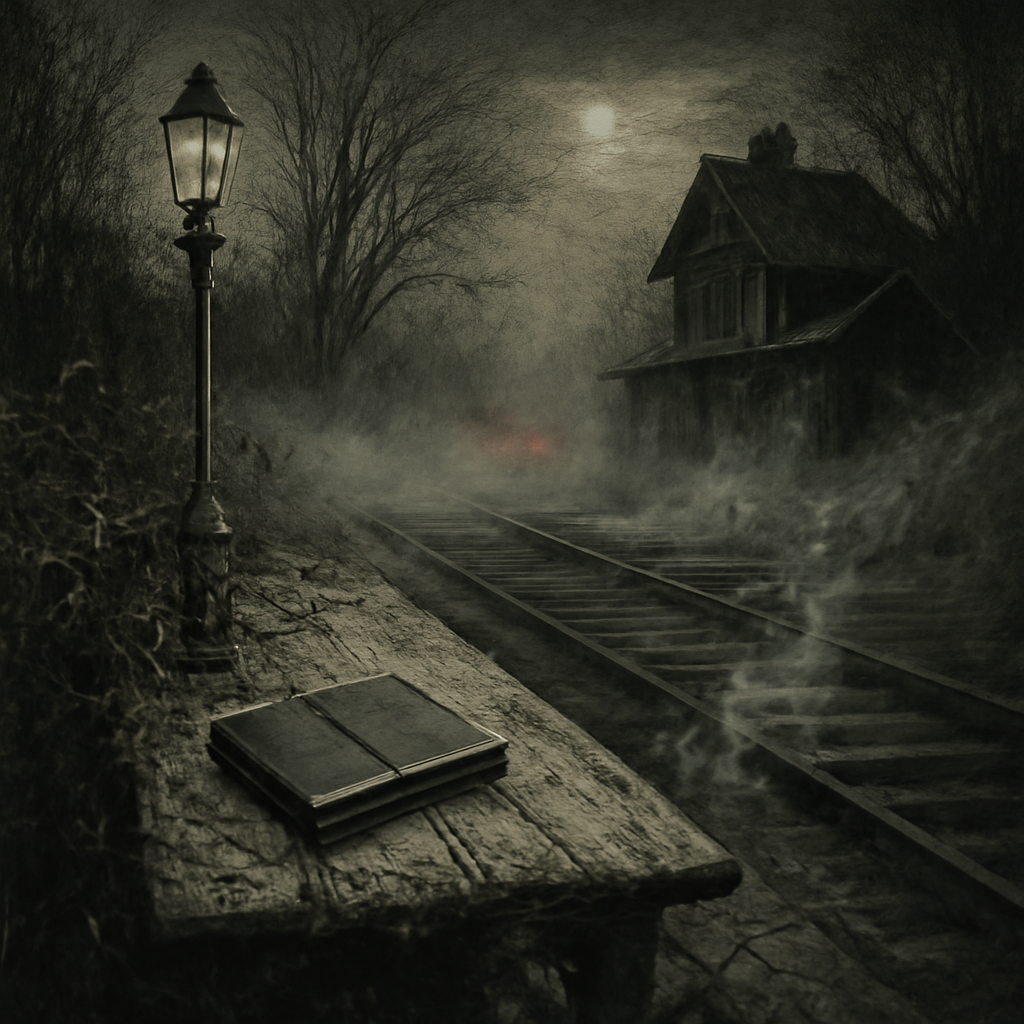
Along the desolate stretches of what once was the East Prussian Northern Railway lies the forgotten halt of Schattenburg. Long since abandoned and surrendered to the wild, this forlorn platform endures only in half-remembered lore and the rusting bones of rail. Shrouded in melancholic mists and the ceaseless caws of distant ravens, the halt is reputed to be haunted by echoes of a past too grievous to mingle with the living.
It was here, in the winter of 1879, beside the cracked and timeworn timbers of the waiting shelter, that a traveller chanced upon a peculiar relic: a black notebook of unyielding leather, embossed faintly with a faded sigil—some arcane emblem lost to modern knowledge, yet alien enough to unsettle the mind. The traveller, a local scholar fascinated by the arcane and forgotten customs, soon found this volume to be no mere ledger or diary but a repository of spectral whispers.
The pages, yellowed and brittle with age, contained entries penned in a hand both confident and unnervingly precise. The ink itself seemed to shimmer faintly in starlight, a dark symphony of shadows pressed into cellulose. Within these scriptural margins lay chronicles that blurred the line between reality and nightmare: detailed accounts of a spectral conductor who presided over phantom trains, drifting eternally between twilight and dawn, ferrying souls undone by tragedy or despair.
The notebook’s contents spoke thus:
- Descriptions of trains that appear suddenly amid heavy fog, their carriages composed of a blacker-than-night metal, windows aglow with an otherworldly crimson light.
- Reports from nameless witnesses who claimed to have boarded such trains, only to find themselves plunged into labyrinthine realms where time and identity fractured.
- Deranged musings on a terrible figure known as Der Schattenführer — the Shadow Conductor — said to harvest the lamentations of lost travellers and weave them into spectral railways that cross mortal and infernal worlds.
The final words of the notebook curiously reference “the hour when the last whistle will wail, and the halt of Schattenburg shall return to shadow’s embrace, taking its dark cargo to realms beyond remembering.” After this ominous entry, the book abruptly ends; the last pages are stained with smudges resembling dried blood or rust.
To this day, the halt remains an unmarked scar upon the map: no trains call here, no timetables acknowledge its existence. Yet on fog-drenched nights, locals whisper of a faint whistle that drifts upon the wind, a cold breath that carries lament, warning, and invitation. And if you should find yourself near the ruins at such an hour, keep your eyes upon the rails—for in the fleeting shadows you may glimpse the ghostly approach of a train never meant to carry the living.
Thus the black notebook of Schattenburg endures, a grim testament to the place where the earthly and the spectral converge—an artefact of unease, urging the curious to beware the paths not meant to be walked.