The Mask of Frostwacht
A private letter from East Prussian historian Friedrich Albrecht to a confidant, recounting the sinister discovery at the snowbound posting station of Frostwacht in the winter of 1871.
To my esteemed colleague Herr Reinhardt,
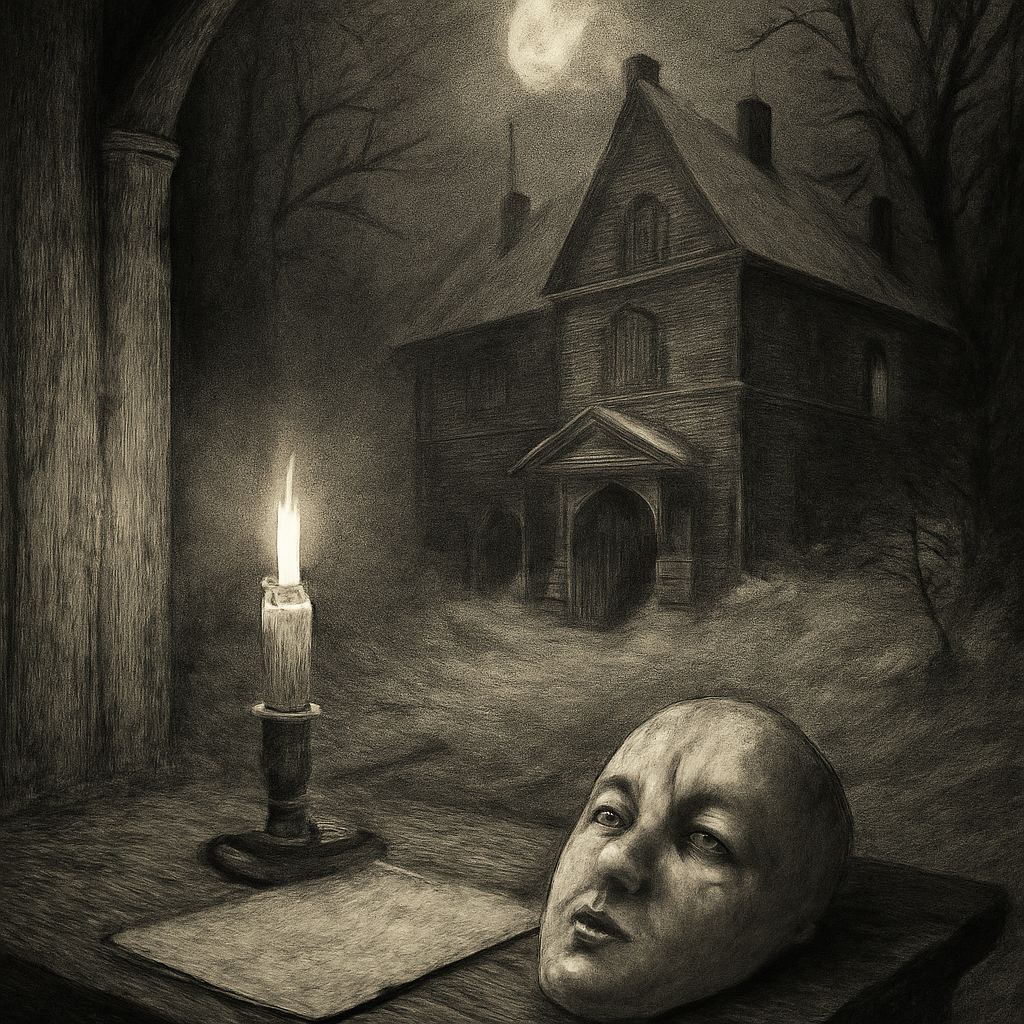
It is with a most troubled mind that I set quill to paper in this grim hour, penned by the flicker of a failing candle amidst the unyielding frost that besets the isolated posting station of Frostwacht. Here, far beyond the comforting lights of Königsberg and swallowed beneath an unbroken veil of snow and silence, I have taken refuge these past weeks in the vain hope that the still air—ominously devoid of even a whisper of wind—will grant some quietude to my restless spirit.
Yet it is within this very stillness that I chanced upon a relic so imbued with dread that it has transformed my understanding of our region’s darker legacy. I found it concealed within the forgotten attic of the station keeper’s abode, buried beneath discarded winter garments and brittle bundles of once-cherished correspondence. Its form is that of a porcelain mask, cracked and stained by the breath of many winters—its delicate artistry betraying no hint of the torment it contains.
The Mask's Appearance and Aura
The mask is of the pale white so prized in the porcelain crafts of KPM Berlin, yet marred by a latticework of fissures that web across its surface like frozen blood vessels. The expression it wears is curiously serene, yet unreadable—chillingly free from malice, but also from mercy or joy. It neither smiles nor frowns; it is as though some veiled eternal anguish was sealed behind its eyes, left forever to gaze without seeing.
Touching it, I felt an inexplicable heaviness suffuse the room, an oppressive weight that seemed to stem less from the mask itself than from the suffocating atmosphere of the posting station and the encircling wilderness, locked in endless frost. The stillness beyond these walls is unnatural; not a bird ventures; not a whisper of wind stirs the snowdrifts. Even the hearthfire's crackle inclines to silence, as if respecting an ancient interdiction.
A Whisper of History
The mask’s provenance remains obscure, yet some obscured documents stowed nearby hint at a tale entwined with the turbulent year of 1806, when the old Teutonic borderlands witnessed strange happenings. It is said a local noblewoman, Frau von Ecken, infamous for her occult dabblings, vanished amid a brutal winter storm at this very station. Rumours murmured then of a curse fall'n upon the land, of spirits frozen mid-breath in perpetual vigil.
Whether this mask was hers, or a talisman wrought for those lost between realms, I cannot say. But I am compelled to believe it is no mere ornament. The mask carries with it a legacy of frozen sorrow and hushed terror, a finite boundary between the seen and the unseen, thence resolved in cracks like ice fracturing beneath strain.
My Warning
Do not imagine, Herr Reinhardt, that such a relic lies inert, fit only for somber study or antiquarian curiosity. The atmosphere it conjures is a palpable shroud—one that suffuses the very air with dread and leaves no quarter for solace or hope. It is a vestige of East Prussia’s spectral soul, an echo of lives lost beneath the unrelenting snow and a stillness that is far from innocent.
I have resolved to convey this mask henceforth to the archives of Königsberg, where learned eyes may unravel its secrets. But I counsel you, and all scholars who would pursue the dark veins of history beneath these lands: tread lightly for Frostwacht’s winter is eternal, and its still air a sentinel that heeds no mortal intent.
Yours in uneasy fellowship,
Friedrich Albrecht, March 1871, Frostwacht