The Drowning Tones of Lindenkrug
An account of a haunted cellar and its spectral echo in East Prussia, 1893
Travel Journal: Herr Quetzlinberger
29th September 1893, Near Königsberg
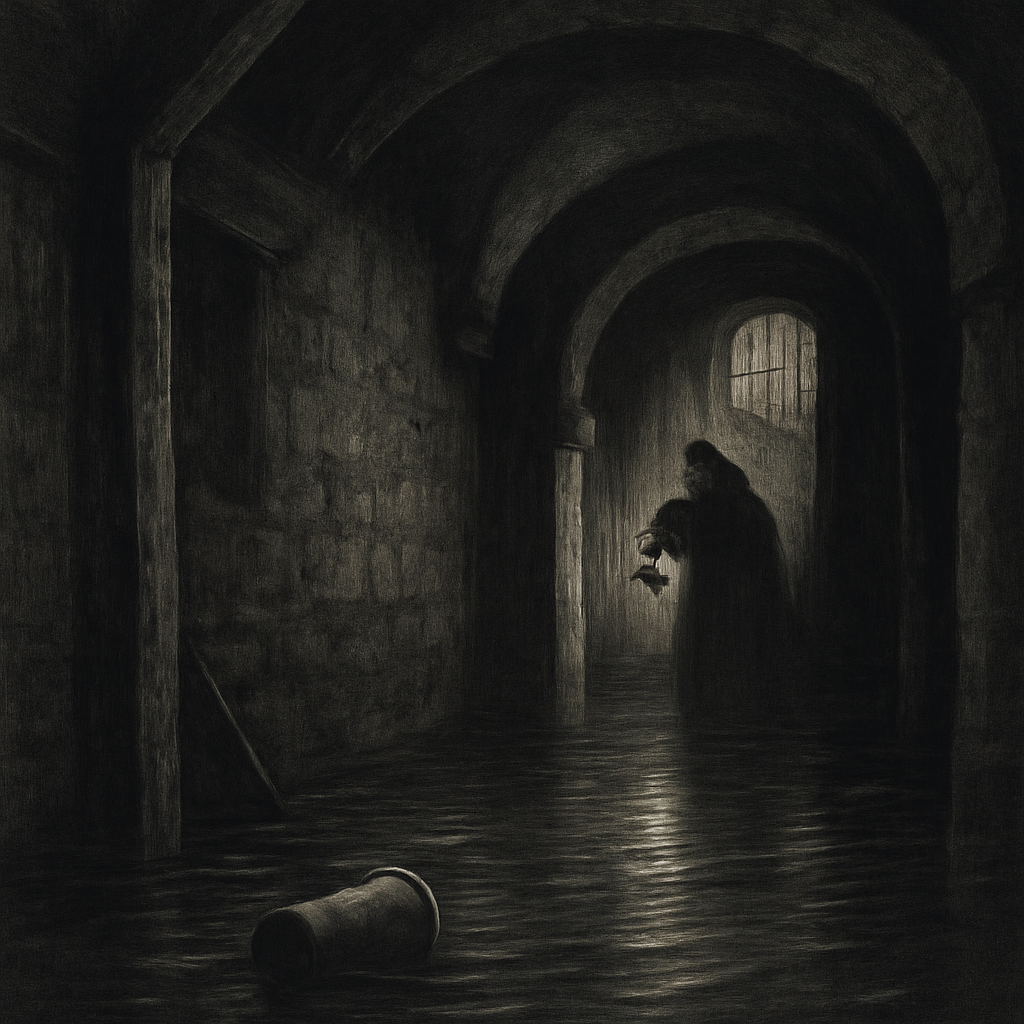
The evening descended upon the hamlet of Lindenkrug with a dusk so persistent it seemed the sun had chosen to linger wearily beyond mortal ken. Beneath the weary inn at the village’s edge, there lies a cellar, once dry and stout, now given over to a slow drowning by persistent rains and the restless seepage of the earth. It was into these flooded bowels of the old Weiss Adler Inn that I, Herr Quetzlinberger, ventured—a journey not borne of idle curiosity but an irresistible summons from whispers long wafted upon the evening air.
The villagers had spoken in hushed tones of soft murmurs emerging from the deep, as if voices were trapped beneath the waters where none might hear save the drowned and forgotten. Carrying naught but a flickering lantern and my faithful walking stick, I descended the crumbling steps into an abyss of dankness and shadow. The air was thick and smelled of rot and ancient timbers, a melancholy perfume that filled the lungs with a sorrow as if the very stones wept.
Within this subterranean tomb of timber-splintered walls and brackish pools, I found the object of my search: a wax cylinder, half-collapsed and stained dark with moisture and time. The vessel of sound—a relic from the more optimistic days of Guenter’s invention—now lay broken but strangely alive, as though it still harboured the faintest vibration of a lost melody beneath its cracked surface.
The Wax Cylinder
The cylinder was discovered upon the qanat-like floor, partially submerged and weighted by a corroded iron disc, perhaps once a cap or a seal. Its grooves were faintly visible, fragile lines turning upon themselves in an eternal, silent lament. The very thought of sound incarnate, thus imprisoned and soaked, troubled me deeply. I dared not attempt its playback; such modern artifice would be an impossible intrusion into this solemn, drowned sanctum.
Instead, I attempted to decipher what the cylinder may have contained—a lament or a dirge? An invocation? The village folk recall in broken passages of an itinerant cantor who frequented the inn long ago, his sombre hymns filled with longing and despair. Was this his voice, now imprisoned beneath the stagnant waters?
The Long Dusk
Outside, the dusk held, resisted night’s dominion. It was as if time itself lingered, unwilling to cast down the last embers of daylight, creating an atmosphere of suspended melancholy. The cold breath of the encroaching night mingled with the damp cellar air, and the flickering lantern cast dancing shadows on the water’s surface—ghostly shapes that seemed to echo the sorrows contained within the wax.
Reflections and Reverie
This twilight jail of sounds swallowed by water—an echo chamber of lost hopes—reminded me that all things perish eventually, even those carved from wax and sound. There is a grievous beauty in this ruin, and I cannot help but feel a kinship to the cylinder’s slow decay and forgotten purpose. To speak of such things risks dismissal in these modern times, but here, in the long shadow of Lindenkrug, the past persists in melancholic resonance, whispered only to those who dare listen closely.
- Location: Flooded cellar beneath Weiss Adler Inn, Lindenkrug
- Object: Damaged wax cylinder, 19th century sound recording
- Date: September 1893
- Weather: Protracted dusk, oppressive moisture
- Observer: Herr Quetzlinberger, traveller and chronicler
May these fragments of memory carry onward the solitary song that even water could not silence.