The Brass Key of Marienklint
An archaeological observation from the ruins of a Teutonic watchtower battered by cold sea winds in 1847.
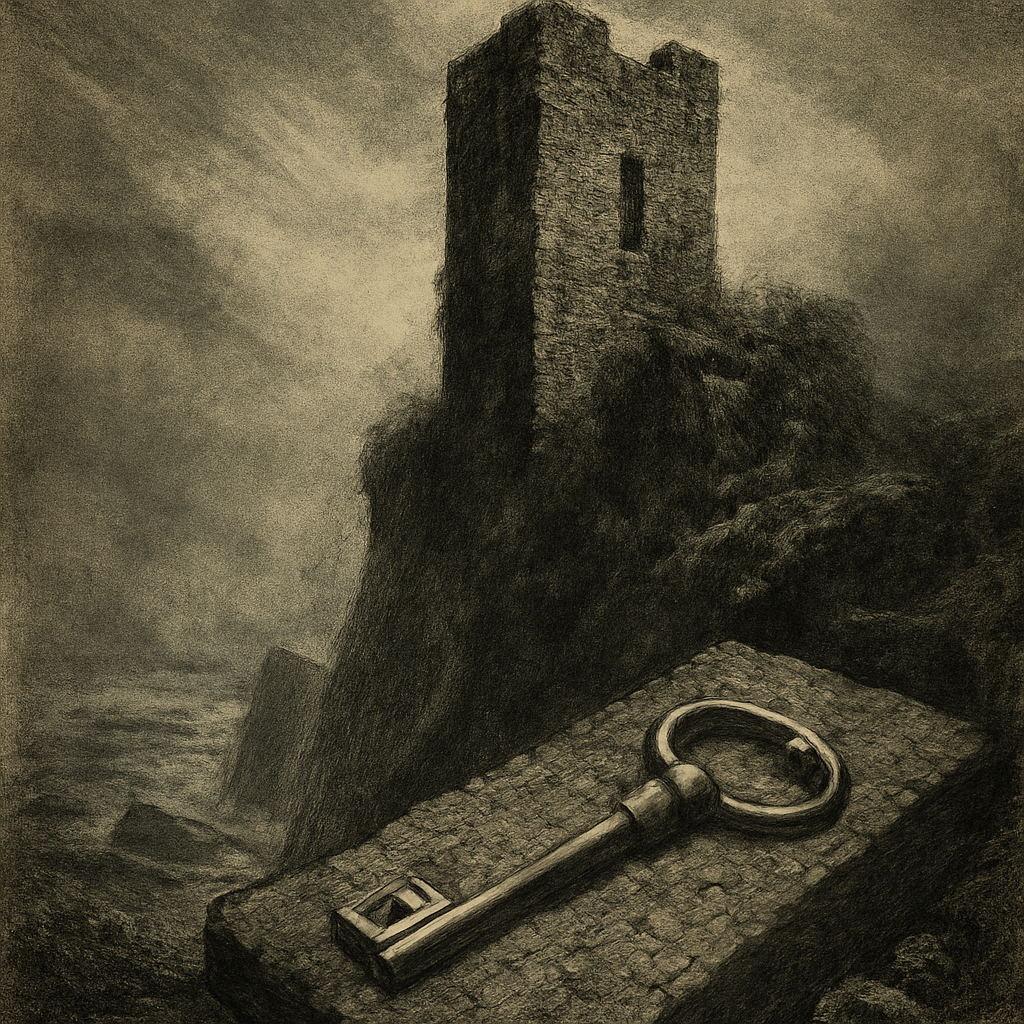
Archaeological Note: The Brass Key of Marienklint, August 1847
By an unnamed archivist attached to the Königsberg Historical Society
Among the bleak, salt-bitten cliffs of East Prussia’s western shore lies the desolate ruin of a Teutonic watchtower, known locally as Marienklint. Its weathered stones stand fractured and lichen-swathed against the ceaseless assault of cold sea winds, which howl like long-forgotten souls through the skeletal remains of battlements and arrow slits. The year is 1847, and I have ventured to this forsaken sentinel, compelled by whispered tales preserved in brittle charters and the half-forgotten murmurs of coastal fishermen.
This tower, once a proud vigilance post of the Ordensstaat, has long been abandoned to the slow repose of ruin and decay. Yet beneath a fallen slab and tangled briars, I unearthed a curious object: a small, unadorned brass key, corroded but intact, its wards worn smooth as if by ceaseless turning. Such a key in this barren solitude is an enigma most profound. What portal might it have unlocked? What clandestine chamber or sacrament did it guard?
The key is inscribed with a faint mark, almost effaced, that I believe to be a sigil of the Teutonic Order, though distorted by time’s cruel hand. Its very presence in this place conjures melancholy—a haunting reminder of mortal endeavours undone and secrets lost to restless winds. The surrounding stones whispered of watchmen long passed, their names erased save for shadowed chronicles in ancient ledgers hidden deep within Königsberg’s archives.
It was on a bitter morning, when the sea mists lay heavy and the north wind bit like a scythe, that I first held the key in my trembling hand. The ruins seemed alive with an unspoken sorrow, the ghosts of sentinels caught between realms. I am certain that the key was not a mere trinket; rather, it likely played a part in ritual or cryptic safekeeping, a talisman intertwined with the Tower’s spiritual or martial guardianship.
Yet one must consider the darker tales: local villagers speak in hushed tones of an ancient curse hailing from this place—of shadows that linger where this key now rests, summoning spectral watchers still bound to their watchtower in death as in life. The key may be less an instrument of lock and more an anchor to a realm beyond mortal ken. To possess it is to brush the fragile veil that separates time and oblivion.
The tower itself has succumbed to both nature’s cruel whims and neglect, no longer a bastion against invaders but a sentinel of desolation. Crumbled masonry is overgrown by thorn and heather, the mortar cracked and salt-etched, while the pervasive chill from the sea imbues the place with a relentless melancholy. Here, the daylight is seldom warm, shaded always by drifting fog and the mournful cry of distant gulls.
In this context, the brass key stands as a vestige of a vanished world—where cold stone met colder duty, and faith entwined with swordcraft beneath a shadowed cross. It is a singular shard of the past, echoing with vestigial meanings beyond the grasp of present knowledge.
I leave this note as testament to the strange find, mindful that its true purpose may forever elude us, its mysteries swallowed by the relentless sea winds and the slow decay of centuries. The Brass Key of Marienklint remains, like the tower itself, a relic of melancholy and spectral watchfulness, waiting silently beneath the endless grey heavens of the Baltic coast.