Whispers from the Electric Moon
A 1959 lunar survey camp’s transmitter catches more than just cosmic static.
Scientific Abstract: Lunar Radio Transmission and Unidentified Signal Phenomena
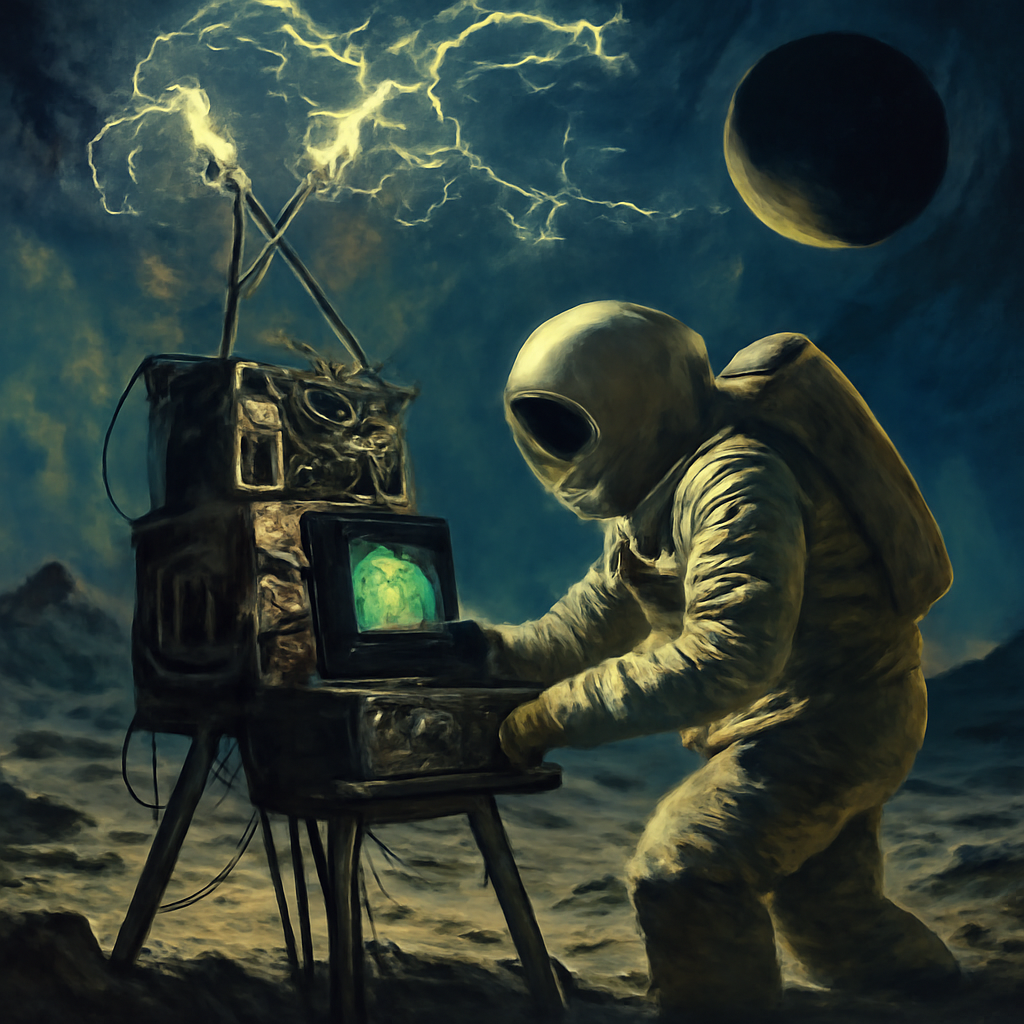
At Survey Camp Echo-7, situated within the basins of Mare Tranquillitatis, a radio transmitter assembled from surplus vacuum tubes, scavenged coils, and repurposed magnetic tape drives has achieved unprecedented signal emission on 23 November 1959. Under the restless gloom of frequent electrical storms—an atmospheric oddity unanticipated by Earthbound meteorologists—Chief Radio Engineer Nigel Branwell reports a transmission that defies known cosmic interference patterns.
Initial construction of the transmitter was utilitarian, fashioned in the cramped laboratory module from remnants of terrestrial wartime stockpiles and disused government surplus electronics. Branwell, whose expertise in vacuum tube oscillation circuits is well noted, deployed a homemade modulation technique inspired by radio operators of the Great War but adapted here for lunar environmental conditions. The transmitter's success was tested against the harsh vacuum and the electrically charged storm fronts that loomed like spectral titans over the camp’s antennas.
During a routine calibration sequence, a transmission burst was received not solely as a standard ping, but with irregular, patterned echoes hinting at structured repetition beyond the anticipated feedback. The camp's magnetic tape logging devices recorded these curious reverberations. Upon playback, the signals exhibited oscillations that matched no known terrestrial or cosmic radio source. Observation logs note an uneasy atmosphere among the crew—howls of the electrical storm outside seemed to synchronise faintly with the mysterious pulsing.
Branwell’s report emphasises the technician’s initial triumph tinged with apprehension. He wrote:
"The transmitter, cobbled together from what most would deem rubbish, has instead become the key to a whisper from the lunar void. Yet, what this voice 'says'—or the intentions behind its rhythmic call—remain unrevealed. Our victory in sending a signal beyond the Moon is marred by a creeping doubt that perhaps we have not only broadcast into the void but beckoned something back."
While the official government files remain classified, with references shadowed behind code names such as ‘Project Helios Echo,’ fragments of data suggest continued surveillance and additional expeditions to monitor the phenomenon. Allied observatories on Earth detected faint reflections during the storms, corroborating the lunar camp’s recordings.
The findings open pathways to unknown electromagnetic interactions influenced by lunar charged weather—a newly appreciated challenge for radio engineers of the nascent space age. With each electric discharge over Mare Tranquillitatis, the camp's rickety, triumphant transmitter might be coaxing secrets out of the silent void—or inviting enigmatic answers borne on cosmic winds.
- Location: Mare Tranquillitatis Survey Camp Echo-7
- Date: 23 November 1959
- Weather Phenomena: Persistent electrical storms exhibiting charged plasma discharges
- Key Technology: Vacuum tube-based radio transmitter built from surplus wartime components and recycled magnetic tape drives
- Lead Scientist: Radio Engineer Nigel Branwell
- Observatory Notes: Unidentifiable echoed signals detected, possible electromagnetic anomaly
This record reminds us that even in an age of electric lights and moonlit laboratories, the cosmos retains its mysteries—waiting in the crackle of a vacuum tube and whispered across the magnetic tape between storms.