Ghostcard Echoes
A transit police analyst uncovers fractured truths in a municipal memory-storage depot’s surveillance transcript.
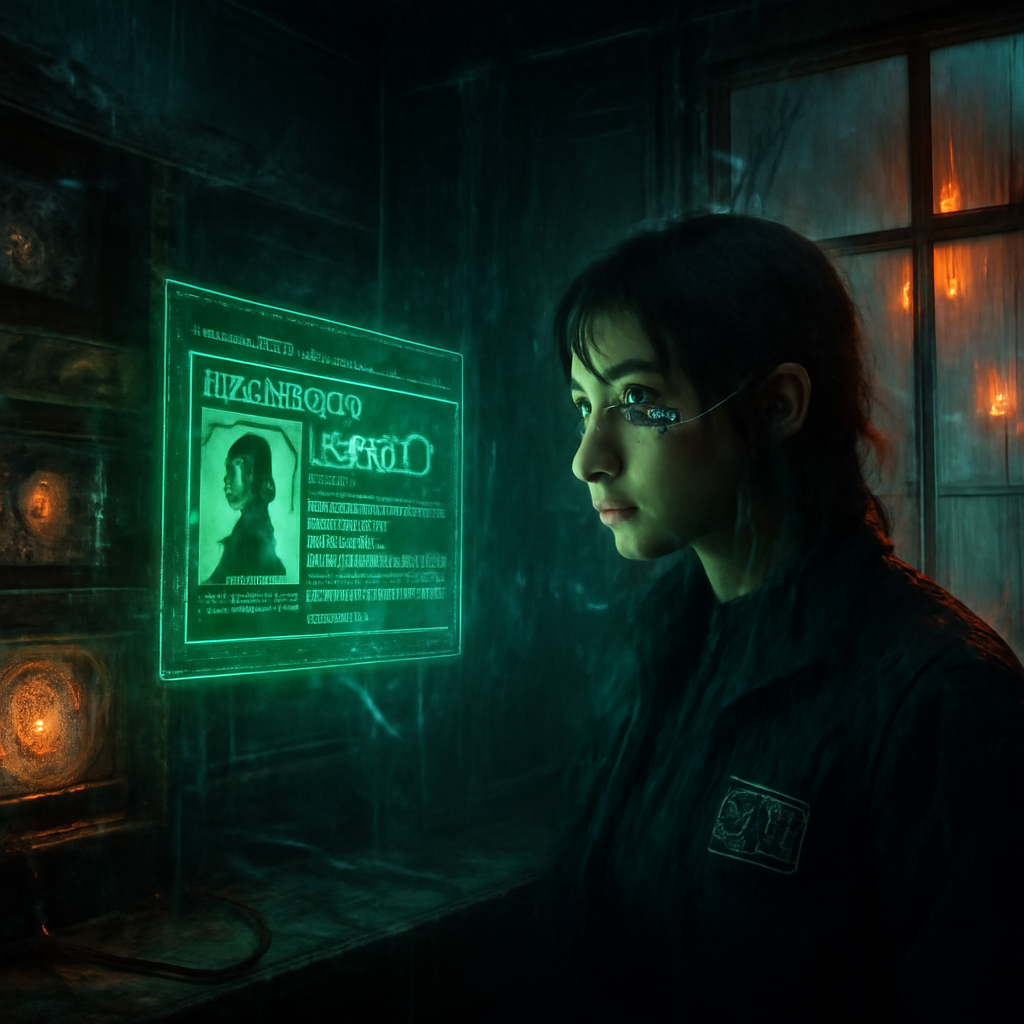
Municipal Memory-Storage Depot, Sector 7G — 2049
The sun had long surrendered behind the drab horizon of the city. Outside the depot’s stained glass and rusted alloy framework, a warm neon drizzle slicked surfaces, turning the cracked concrete and flickering holo-signage into dreamlike, trembling reflections. Within these walls, where the city’s forgotten moments lay stacked in decayed racks of obsolete core drives and glass-encrypted discs, sat Maya Hanzo—transit police analyst and conspiratorial archivist—sifting through a surveillance transcript of questionable provenance.
The depot was an architectural chimera—half-abandoned municipal facility fused with retrofitted neural grid nodes. Once designed to store public data memories for identity verification, it had since become a liminal vault of shadows where memory ghosts and corporate secrets interlaced in a toxic dance. Surveillance cameras—long since made unreliable by scavenged jammers and warped firmware—fed Maya slices of fragmented footage and corrupted audio logs. What she sought was both routine and elusive: the origin trail of a counterfeit identity card tied to a sprawl-wide raise in transit fraud.
Transcript Excerpt - Warm Neon Drizzle: 03:48:22 - 04:15:57
- Audio distortions interleave with static, voices whisper behind layers of encrypted chatter.
- Caller A: "...the card’s lockstamp is archaic. Synthetic fibres not matching any city-authorised batch since ’44 lockdown protocols."
- Receiver B (unknown): "You’re chasing ghosts in a decayed system. Records wiped under three corporate mergers. No official trail past third party nodes. Trust the visual logs, if you can call them that."
- Flickering video: blurred visage of a woman exchanges a small, worn card beneath a shattered plexiglass platform at the Kyntar transit terminal.
- Unidentified figure's voice, low and alert: "Surveillance meshes offline... Data localised, no uplink. This was deliberate. Someone doesn’t want this to surface."
- Timestamp glitches, the card’s embossed ID flickers—numbers morph between states, alternately revealing and concealing the bearer’s identity.
Maya replayed the segment, noting every anomaly with paranoid care. The counterfeit card wasn’t merely forged; its neural imprint triggered recursive loops in memory verification systems—an intentional sabotage layering unreliable human and machine records. The neon-green holographic ID flickered intermittently in the transcript, mirroring the persistent drizzle outside, blurring the lines between truth and fabrication.
The depot’s deteriorating infrastructure whispered secrets—pipes groaning under synthetic rain, datastreams corrupted by years of neglect and corporate sabotage. Between layers of encrypted static, Maya discerned corporate ciphers—fragments of long-erased data contracts hinting at the involvement of Ardent Corp, a shadowy tech giant notorious for extracting and manipulating citizen memories under legal pretences.
Her paranoia was not unfounded. The city’s surveillance grid was a maze riddled with intentional dead zones and false positives. The transit system, a vector for daily control and public data collection, now lay rife with subversion. The counterfeit identity card was more than a smuggled secret; it was a cipher key to an underground network exchanging identities as currency, eroding trust in every neon-lit terminal and underground rail.
Maya’s notes, polaroid scan attached:
- Corruption pattern aligns with cold cases of vanished commuters post-'47 cyber unrest.
- The card’s creation locality traced to a derelict storage node underneath the former Q-Line control hub—now a slum of data ghosts and analogue graffiti.
- Impossible to conclusively link bearer identity due to recursive data loops corrupting AI recognition subroutines.
- Surveillance transcript timestamps mismatch with physical logs, suggesting intentional backdating or temporal obfuscation.
The faux identity card was a ghost mapped onto the city like a virus, hidden within the mire of warm neon drizzle, disbelief, and crumbling facades. The more Maya dug, the more the line between observer and observed blurred. In 2049’s neon-lit rain, memory was as fragile and unreliable as the decaying depot itself—and paranoia a necessary lens for any search of truth.