The Black Notebook of Königsberg
A police report from the locked municipal archive, 1893
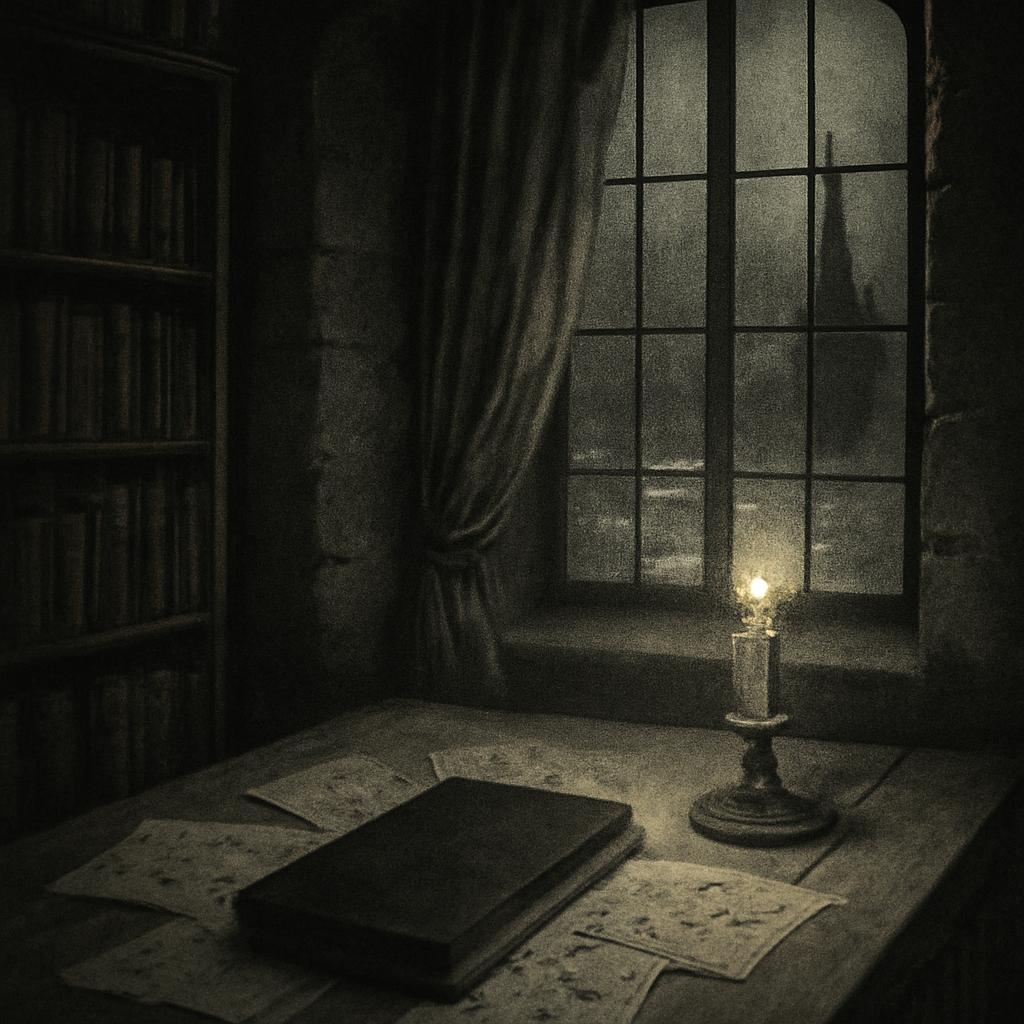
The Case of the Black Notebook
In the year of our Lord 1893, on a night beset by cold sea winds that howled through the lantern-lit streets of Königsberg, a curious document was recorded within the sealed municipal archive. The following represents a faithfully transcribed police report concerning an object of peculiar nature—a black notebook, its bindings worn and unyielding, discovered under most enigmatic circumstances.
Location: The municipal archive, a chamber usually forbidding and locked, perched above the restless Baltic, where the sea’s breath chills even the bones of the strongest.
Report dated Michaelmas, 1893
Subject: Theology student Herr Albrecht Stein, aged twenty-three, recent arrival from the University of Erlangen, was summoned to deliver testimony relating to the black notebook. The item first came to notice when archivist Herr Langsdorf found it wedged between the pages of an uncatalogued ledger, under a loose floorboard beneath the record office.
Accounts from Herr Albrecht Stein
Herr Stein, a youth of introspective countenance and devout habit, recounted how his nightly walks along the harbour promenade were disturbed by a dreamlike vision of a manuscript calling to him; a dark tome murmuring secrets no tongue should speak aloud. According to the student, the object wielded a presence not unlike the whisper of the old cathedral’s crypts—a palpable unease mingled with discovery.
He described the notebook’s surface: "Of a matte blackness, fragile yet dense as the ether beyond mortal sight. The ink within seemed to absorb the light, as if inked by shadows rather than pigment." Herr Stein admitted to opening the book by candlelight, revealing pages inscribed with indecipherable glyphs, esoteric diagrams, and strange psalm-like verses whose language defied not only Latin but all known tongues.
Stein’s testimony hinted that the pages seemed mutable, altering when unobserved; symbols shifting and recombining beneath his eyes, a phenomenon that arrested his rational mind and urged a withdrawal to theological contemplation. He posited the object’s origin not as earthly, but as an artefact of arcane forces, a bridge between the mundane and the uncanny, hidden deliberately from mortal comprehension.
Weather and Atmosphere
On record, the night the notebook was unearthed was marked by a storm rolling in from the sea, carrying frigid gusts that rattled the shutters and set the ancient gas lamps to quivering. The document reiterates this as no mere coincidence, noting the old sailor’s superstition linking the tempestuous clime to the stirring of forgotten things—creatures, or memories, that should remain silent beneath the tides.
Additional Observations
- The archivist’s account declares the notebook impervious to fire, water, and knife—efforts to mar its surface resulted only in deeper black fissures.
- An unidentifiable scent, reminiscent of damp fog and burnt incense, clung persistently to the object and the room’s air after its discovery.
- Herr Stein suffers from intermittent trances, stating he has glimpsed "nebulas of spectral forms" hovering just beyond perception in the folds of the night.
- The notebook was secured within a lead-lined box, itself locked in the deepest chamber of the archive—no subsequent access permitted without explicit municipal order.
Closing Remarks
The report concludes in a tone bordering on awe and dread, warning that the notebook may be a conduit of supernatural knowledge, a fragment of a darker theology lost since the Paleolithic nights when men first turned their gaze skyward with trembling.
Thus the Black Notebook remains a sealed riddle, held fast in its maritime vault, a vestige of shadows among cold stone and salt winds—whispering in silence to those who dare to listen.