The Chime Beneath the Snow
An archaeological note on a subterranean bell heard beneath Königsberg in the winter of 1893
Introduction
It was during the relentless snows of Christmas Eve, 1893, that I, Johann Albrecht, a humble student of theology at the University of Königsberg, first heard the whispered rumours concerning an ancient bell concealed somewhere beneath the municipal archive. My scholarly pursuits had led me frequently to these dusty chambers of memory, where the city’s forgotten secrets lingered like shadows in thickened air; on this occasion, however, a chill stranger than the biting frost crept upon me, drawn not from the biting wind but from something far beneath the cobbled streets.
The Archive in Winter
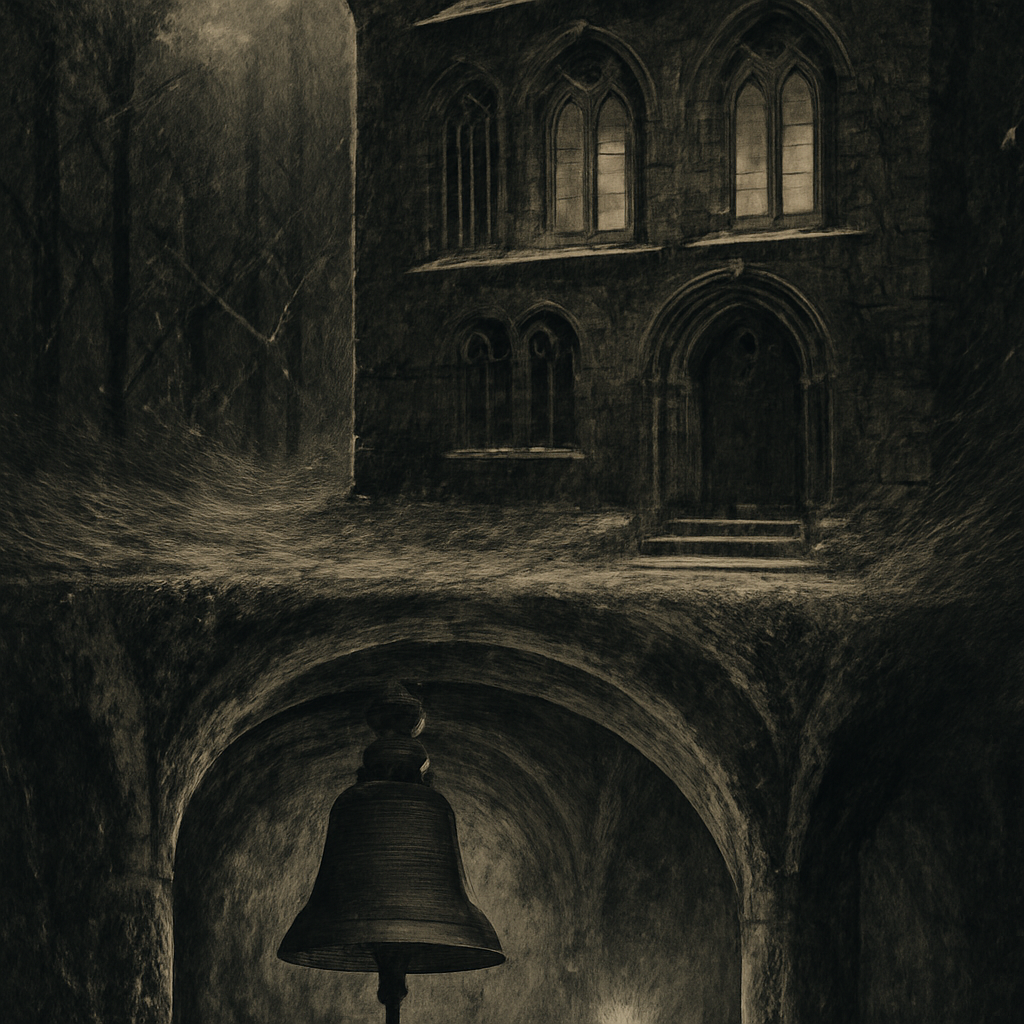
The Municipal Archive, a stout, brooding edifice of blackened stone, stood locked and swathed in a shroud of heavy snow. Its barred windows were glazed-over portals, from which little light escaped and no warmth could be discerned. The snow fell in measured silence, a soft and unyielding veil that seemed to isolate it from the familiar world above.
Within the vaulted recesses, where ledgers and parchment scrolls lay inert as ancient bones, I encountered an old custodian, his pale face half-lost behind a frost-spattered windowpane. He spoke with a voice as brittle as dry twigs, relaying a whispered tale:
- Of a bell, unlike any other, suspended deep beneath the city’s ancient foundations;
- A bell said to toll in solemn cadence, though unstruck by mortal hand;
- Its resonance, a lament scholar and townsfolk alike dared neither to confirm nor deny.
The Account of the Bell
Legend tells that the bell was cast in the twilight years of the Teutonic Order’s dominion; a gravework of iron and sorrow, forged to sound the approach of great calamities yet forbidden to ring above ground lest it herald despair prematurely. It now dwells beneath the library annex in a labyrinth of catacombs long forgotten, beneath layers of earth hardened by thick winter snow and years of silence.
That evening, as the storm outside darkened into a palpable heaviness, my footsteps echoed hollowly through the deserted hallways. The thrumming of the city’s heart lay obscured beneath the frozen earth; and yet, through the heavy silence, I thought I heard a distant, sonorous tolling. Twice, thrice—as if the bell were calling not the living, but the restless dead below.
Contemplations of a Theology Student
To a theology student such as myself, raised amidst doctrines of light and shadow, such a phantom toll presented a most perturbing enigma. Bell, as symbol and as instrument, serves to mark time, to call congregations to prayer or warn of spiritual peril. What then, if its subterranean clangs were a summons, not to the faithful, but to something unreachable and jaded in the black depth?
The sound’s persistence suggested not mere echo but a purpose that defied rational explanation. It was a sound that transcended time, forged in the crucible of history’s forgotten agonies, moulded into a perpetual requiem beneath a city cloaked in frost and sealed by authority. I felt caught between the scholarly endeavour to catalogue the known and the disquieting call of the unknown—a bell tolling in defiance of earthly bounds, beneath icicles and sealant stone.
Concluding Reflections
Though my investigations were curtailed by locked doors and forbidding archives, I remain convinced this bell is no mere legend. The snow, heavy and mute, seemed to weigh down not only the roofs above but the tingling air below, where a phantom chime dwells eternal. This bell of Königsberg’s depths rings not for men but for something dourer, a resonance that lingers in the gaps of history itself.
May these notes serve, if not as explanation, then at least as witness to a spectral relic: a bell that tolls beneath the town in the heavy snow of an 1893 winter, calling forth the shadows of yore and the ghosts of the never-forgotten.
Johann Albrecht, Theology Student, University of Königsberg, 1893