The Enigma of the Frostbound Letter
A report from the snowbound Grusendorf posting station, winter 1871
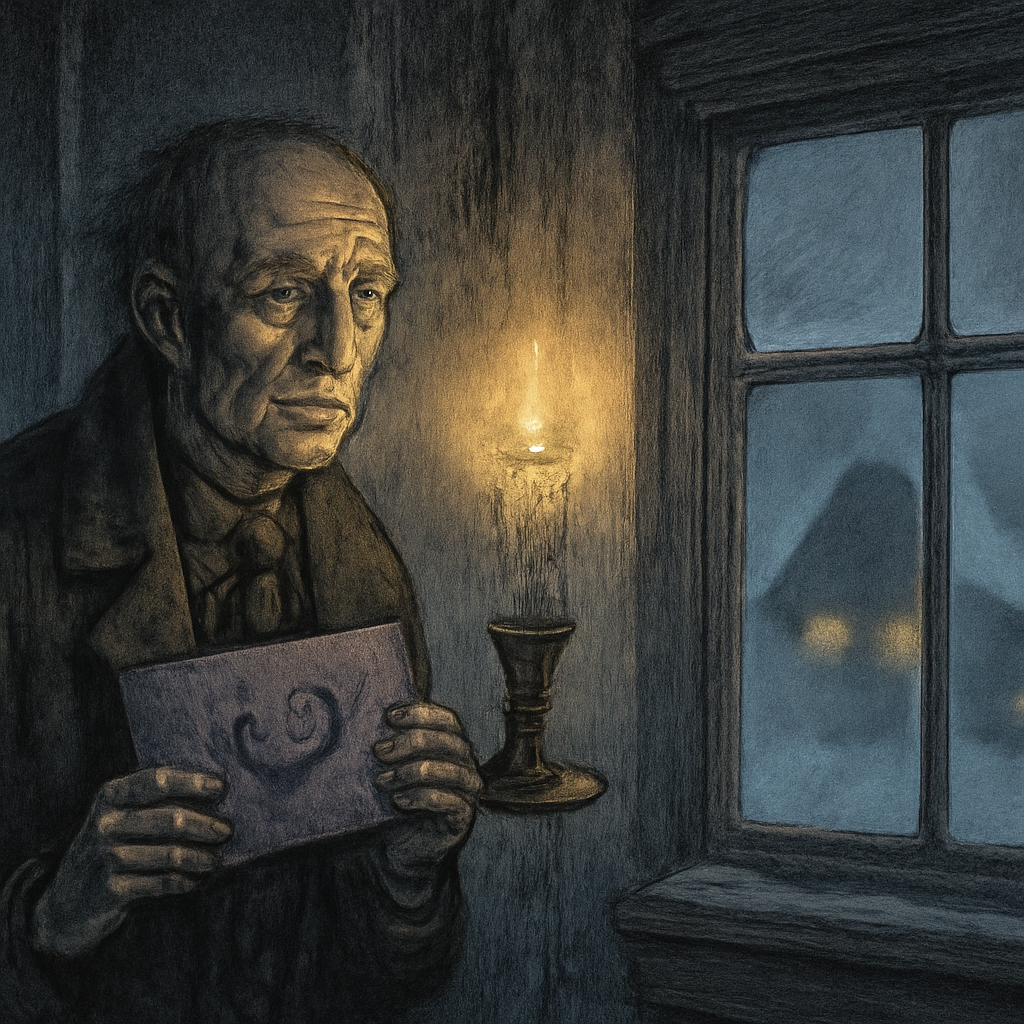
Police Report on the Sealed Envelope Found at Grusendorf
Transcribed from the records of the Königsberg precinct, dated 12 December 1871.
It was upon the third day of the incessant winter fog that enveloped the post station of Grusendorf, nestled amidst the desolate snowscapes of East Prussia, that an object of unusual portent came to the attention of His Majesty's constabulary. The station, a ramshackle dwelling of timber and frostbitten stones, serves as the last outpost before the forbidding border woods and the wilderness beyond.
The station's caretaker, Herr Albrecht Weiss, a man whose slender frame and jumpy gaze bespoke years spent at the mercy of isolation and the biting cold, presented himself at the precinct with a peculiar item: a sealed envelope, unmarked by postmark or address, yet bearing the peculiar stamp of a sigil unfamiliar to any postal authority.
Herr Weiss, on the verge of visible disquiet, recounted the manner in which the envelope came into his possession. The day prior, as the fog wreathed the station in a dreamlike shroud that dulled time and space, he discovered the envelope lying atop the oaken table within the main chamber. No footprints other than his own were discernible in the crusted snow without; no message accompanied the object, nor did any bell or summons herald a visitor.
He asserted, with tremulous insistence, that the envelope could not have been present the morning of his routine inspection—yet in the dimming gloam, with the fog thick as consecrated incense, his memory seemed as fragile as the brittle ice adorning the eaves.
The sealing wax bore a deep violet hue, cracking upon slightest pressure, embossed with a twin crescent moon entwined by raven feathers — an emblem unrecorded in any known catalogue of noble or mercantile houses. The paper, its fibre coarse and eldritch, emitted a faint musk reminiscent of ancient parchment stored in cryptic vaults.
Under cautious examination by officers, the envelope proved impervious to ordinary methods of opening. No blade or flame sufficed to break the seal—indeed, Herr Weiss reported nocturnal noises, whispered in languages lost to the present era, echoing faintly within the walls subsequent to the envelope’s discovery.
Not insignificantly, the caretaker also remarked upon a sensation of perturbation that settled over the station—an intangible chill deeper than the biting winter cold, accompanied by unsettling visions in the fog: fleeting figures glimpsed beyond the frosted panes, shadows bending unnaturally, and a lament as of mourning women borne on the wind.
Given the supernatural nature of these reports, it was deemed prudent to conduct further inquiries and restrict the envelope’s custody until such time as suitable arcane expertise might be summoned from Königsberg or beyond. For now, the station remains swathed in the breathless stillness of the fog-choked winter, the envelope a silent enigma locked against human curiosity and frailty.
Should further developments arise, this report shall be appended accordingly.
Reported by:
Inspector Friedrich Dernbach
Königsberg Precinct