The Prayer Book of Eulenberg Manor
An official memorandum on a most peculiar finding in the abandoned Baltic estate, 1847
Memorandum on the Discovery at Eulenberg Manor
To His Excellency the Royal Inspector of Antiquities,
It is with a mixture of scholarly reverence and unease that I, Friedrich Lenz, engineer and occasional chronicler of the obscure relics within our East Prussian dominions, submit this report concerning the findings at the long-abandoned Eulenberg Manor, situated near the tempestuous eastern shores of the Baltic Sea. The date of composition is the 12th day of September, 1847, amidst an unremitting downpour that has descended upon the region like a watery shroud.
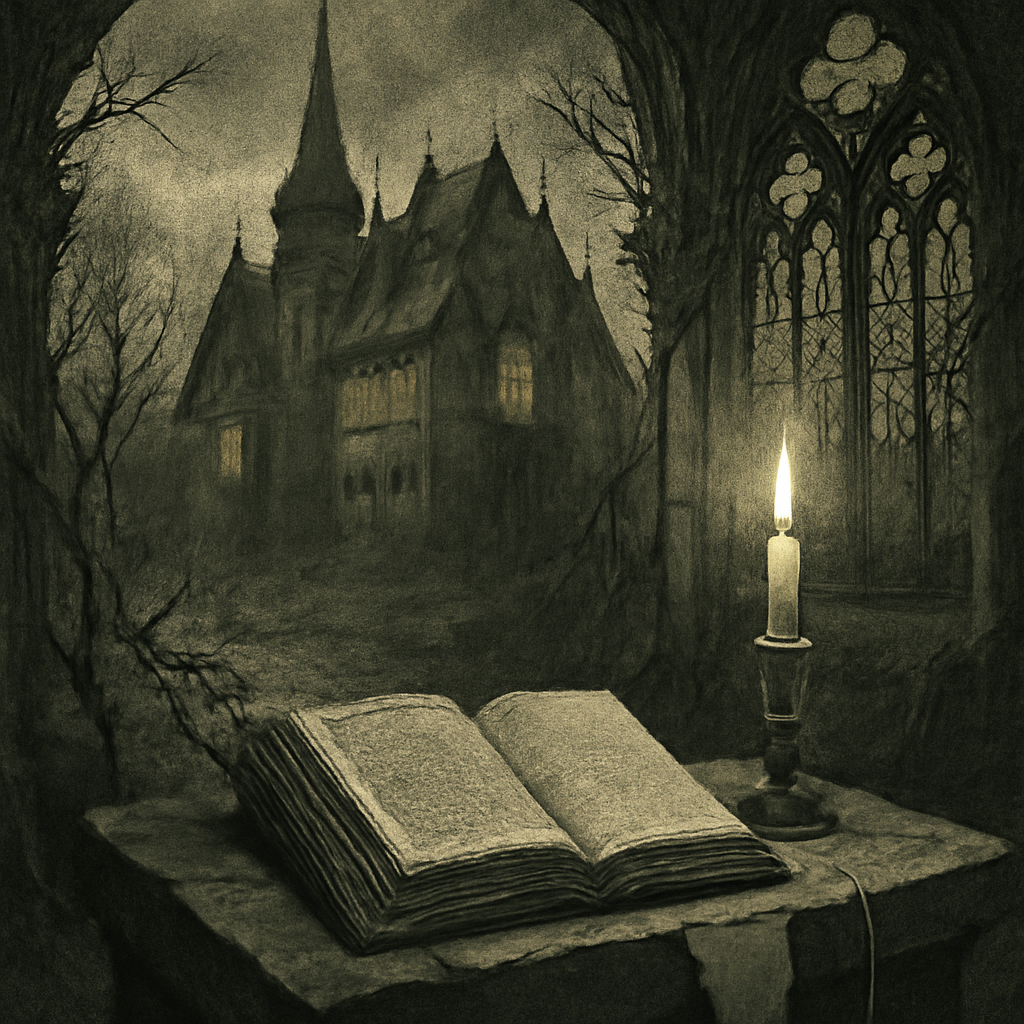
It was under these persistent rains that I journeyed to the desolate estate, once the seat of the noble House Eulenberg, now a silent and crumbling relic of a bygone era, encompassed by brambled hedgerows and gnarled oaks, their twisted branches perpetually swaying with a mournful cadence. The air hung thick with a dampness that seemed almost to hush the very soil itself—an atmosphere of strange peace, as if the manor’s age-old sorrows had settled into a resigned slumber beneath the sodden skies.
My purpose was to inspect the remains of Eulenberg’s outbuildings for potential restoration and to catalog any items of historical import left to time’s mercy. Not far within the dilapidated chapel adjoining the manor’s southern wing, amid scattered rubble and rotting pews, I came across an object both curious and singularly unsettling: a prayer book, leather-bound and etched with faded gold leaf, bearing the unmistakable crest of the Eulenberg lineage.
The book lay open upon a broken altar, its pages yellowed with age, and yet remarkably preserved from the damp, save for one peculiar absence. One page, situated precisely in the midst of the book’s liturgical offices, was missing entirely—cut away with a sharp instrument, leaving behind a faint residue of darkened gluing and the faintest trace of a symbol drawn in nearly indiscernible ink.
Upon close examination, the script that remained was Gothic in style, written in High German as might be expected, but fragments suggested a prayer invoking protection from spirits "that walk between dusk and dawn," a phrase I have not encountered in any ecclesiastical text previously. The missing leaf seemed to have contained some incantation or ritual of transcendence, the absence of which imbued the very pages around it with an odd solemnity.
Despite the manor’s abandonment and the suggestion of restless histories, the immediate atmosphere about the chapel was peculiarly serene; no shrieks or groans, often ascribed to dwellings forsaken and cursed. Rather, a tranquil hush prevailed, as if the manor itself were guardian of the prayer book’s secret, permitting no disturbance beyond a certain pale sanctity.
I confess to an uneasy feeling as I pocketed the volume for safekeeping, for the rain’s ceaseless percussion seemed to echo a silent chant in the dim chapel: a strange benediction or lament, both inviting and forbidding. It is my hope that further inquiry by the learned clergy might illuminate the purpose of the missing page and the nature of the invocation it contained.
In conclusion, this memorandum shall be filed with the provincial archives as a record of an enigmatic fragment of our spiritual heritage, nestled within the ruins of Eulenberg Manor, where time, rain, and silence weave together in a tapestry of mournful grace.
- Location: Abandoned chapel, Eulenberg Manor, Baltic coast
- Date of discovery: September 12th, 1847
- Object: Leather-bound prayer book with a missing page
- Weather conditions: Persistent rain
- Noted atmosphere: Strangely peaceful despite decay
- Reporting officer: Friedrich Lenz, engineer of Königsberg
Respectfully submitted,
Friedrich Lenz