The Unbidden Guest of Danzig Court
An archaeological note on a photographic enigma from a forsaken manor, 1871
Introduction
In the biting cold winds that sweep relentlessly from the Baltic, there lies the ruins of what once was Danzig Court, a manor house abandoned since the convulsions of recent wars and whispered scandal. It is here, amid the salt-bitten stones and splintered timbers, that Herr Johann Kreutz, a theology student from Königsberg, unearthed a fragment of history most unsettling in the summer of 1871. This document endeavours to recount the curious findings he left behind and the terrible chill those findings impart.
The Setting
Danzig Court stood—now stands in ghostly silence—on the edge of the Prussian coastline, where the sea’s cold breath murmurs ceaseless dirges through leafless branches and broken windowpanes. The manor, once a bastion of gentry amid vast estates, fell into ruin after its last lord vanished without a trace in the year of the 1850 uprising. Local villagers aver that a dark shadow lingered on its grounds, a sorrowful presence stifling the wind that dared trespass deeper into the house.
The Discovery
Herr Kreutz, devoted to theological mysteries and the nature of the soul, sought in the manor’s remains an object to prove or disprove spirits’ existence. His prize was a solitary memento cautiously extracted from beneath a collapsed floorboard in what might have been the drawing room: a faded daguerreotype encased in a cracked black wooden frame.
The Photograph
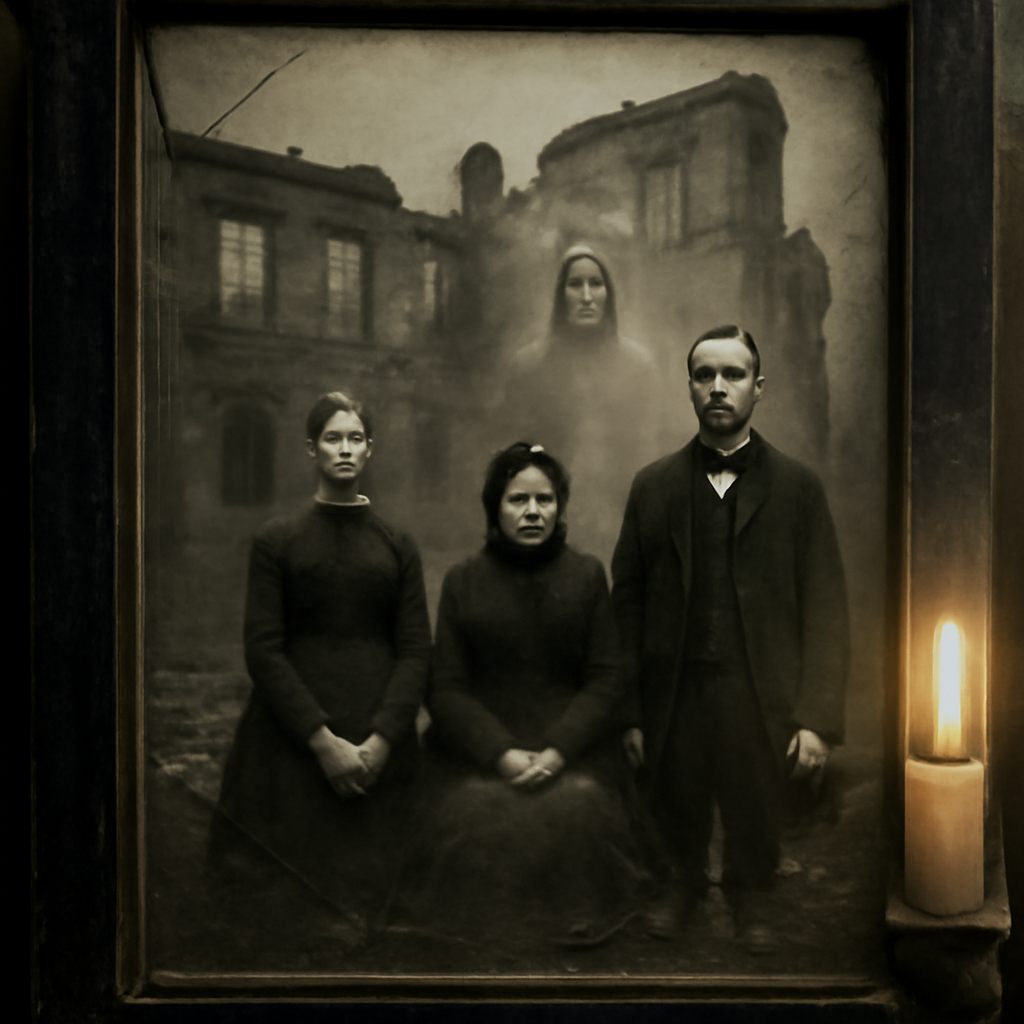
At first sight, the image is a common enough relic of the era: three figures attired in sombre finery pose stiffly before the battered walls of the manor. Two stand formally, a man and woman whose attire suggests the 1840s, while a third figure kneels, head bowed, hands clasped in prayer. Yet, upon closer scrutiny as recorded in Herr Kreutz’s precise annotations, there emerges an eerie incongruity—the count of subjects in the photographic plate is inexplicably one more than the three physically present.
- The Foreground Group: Johann and Elisabeth von Hohenfels, the last known proprietors, identifiable by resemblance to painted portraits still said to hang in village chapels.
- The Kneeling Figure: A cloaked penitent, unnamed, whose countenance is swallowed by shadow but whose presence commands the composition.
- The Spectral Fourth: Glimpsed faintly to the upper left—a translucent figure, with hollow eyes and a face half-obscured by tattered veils, standing where no soul should be.
This phantom figure eluded all explanation of photographic anomaly known to Kreisstadt or Berlin. Kreutz’s theological interests compel him to note the figure might represent a trapped soul, a cursed revenant caught in the camera’s mechanical gaze as if the glass were a portal not to the mere moment, but to the realm beyond.
Weather and Atmosphere
The day of discovery was marked by a relentless squall, the Baltic’s frigid breath rattling the loose casements of the manor and carrying the salt tang of decay. Kreutz’s journal conveys an escalating unease as he handled the image, the cold seeping into his bones akin to the way the manor’s silence pressed upon his thoughts. The winds seemed to whisper warnings of an ancient vendetta borne upon those shifting currents—warnings perhaps meant to go unheeded.
Theological Reflections
As a student of divinity, Kreutz refrains from dismissing the image as mere artistic trickery or a composite of exposures: the apparatus required to produce such spectral duplications is absent from the locality’s humble photographic practice circa the 1840s. Instead, he conjectures that the apparition might be the manor’s final lord, whose spirit, twisted by grief and guilt, forever haunts the earthly plane, manifesting in the image as an unbidden guest.
Conclusion
This note serves not as a full explanation but as a testament to the manor’s lingering melancholy and the unnerving evidence of unseen presences that torment places abandoned by time and mercy alike. Herr Kreutz’s find remains housed at the University of Königsberg’s theological collection, where the photograph continues to invite both awe and dread.
May those who view it heed the cold winds of the Baltic and remember that some images capture more than mere shadows; they capture forgotten souls that wander eternally between worlds.