The Phantom Halt of Windmühlenbruch
An account of the silver compass and the retired captain’s melancholy vigil amid East Prussia’s forgotten tides
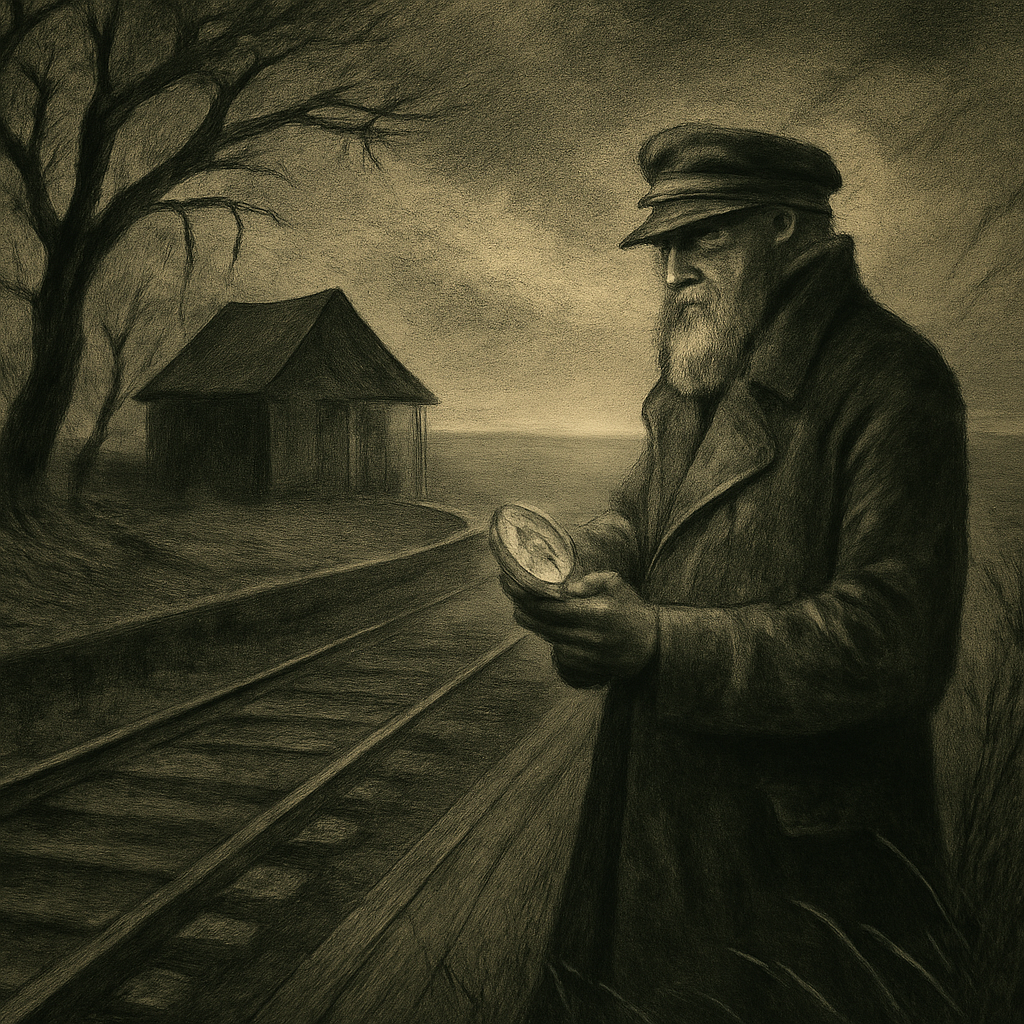
Windmühlenbruch, an obscure and forsaken railway halt upon the waning edges of East Prussia’s coastline, finds itself once more the setting of a peculiar and somber tale. A cold sea wind, bitter as a whispered dirge, sweeps ceaselessly across the saltblasted peat, carrying with it the frail echoes of lost voyages and spectral longings. It was here, during the gloaming hours of October 1912, that the retired Captain Emil von Krantz, a man of no small renown from the old fleets, encountered an object as enigmatic as the desolation itself: a silver compass, gleaming faintly beneath the bleached bones of a shattered railway sleeper.
The Halt That Time Forgot
Windmühlenbruch station, no longer graced by the thunder of iron steeds, stands abandoned, its timbered platform sagging beneath years of neglect, and its signal post rusted into the shape of a crucifix. Local lore murmurs of vanished trains, spectral conductors, and travellers who vanished into the fog—a place where the boundary between earth and oblivion thins beneath the ceaseless howl of the Baltic’s winds.
Captain von Krantz, recently removed from maritime command and burdened by the weight of faded glories, sought refuge here. His was a spirit haunted by the tempests of a lifetime at sea and the quiet devastation of peacetime exile. It was upon a wander along the forsaken tracks, beneath skies leaden and weeping, that his eyes beheld a curious glint amidst the bracken: a silver compass, its surface scratched but unyielding to time’s corrosion.
The Compass of Lost Bearings
This was no ordinary instrument. The needle danced erratically, refusing the cardinal bearings that a mariner’s hand might desire. Instead, it swung with a restless urgency, pointing sometimes inland toward the tangled forests thick with eldritch moss, and at others, seaward, where ghostly fogbanks swallowed the horizon in murmured secrets. The very metal of the compass seemed infused with an otherworldly chill, as if forged not merely by human craft but by some darker hand attuned to the cruel whims of fate.
Von Krantz, with the weary wisdom of one acquainted with both natural and uncanny tempests, was drawn into a silent dialogue with the device. He noted that by daybreak, as the frozen sea winds began to subside, the compass steadied upon a direction neither aligned with maps nor memories but toward a cluster of abandoned lifeboats half-buried in the shifting dunes.
A Silent Vigil
For nights thereafter, the former captain returned to Windmühlenbruch, steadfast in his vigil. Each time the compass called him toward a new waypoint of ruin and desolation: an embattled graveyard overgrown with wild thyme; a half-submerged beacon shattered by storm; a derelict cottage whose hearth had long lain cold. With every discovery, von Krantz glimpsed the ebbing of lost souls tethered to the halt—voyagers condemned to wander in liminal shadows, their courses forever uncharted.
The melancholy of this communion weighed upon him, heightening the spectral isolation that had settled deep within his breast. For the compass, less an instrument than a summons, seemed to reveal not a path, but a curse—a perpetual navigation among the drowned memories of East Prussia’s forgotten coasts.
Chronicle of an Unseen Passage
The newspaper, having gained the captain’s reluctant consent, records this account not merely as curiosity but as testament. A relic of preternatural bearing in a land where the sea and the mournful winds conspire to keep secrets buried beneath centuries of salt and shadow.
- Location: Windmühlenbruch railway halt, East Prussia
- Year: 1912, autumn
- Character: Captain Emil von Krantz, retired mariner
- Object: Silver compass with erratic directionality
- Weather: Ceaseless cold sea winds, fog-laden evenings
Thus is recorded a melancholy chapter in the annals of the uncanny—where man, sea, and machine converge in forgotten rites, and where even the compass, that most steadfast harbinger of direction, becomes an oracle of loss.
— Die Königsberger Nachtrichten, 27th October 1912