The Phantom in Neuendorf’s Dusk
An 1871 photograph capturing one soul too many in a village forgotten by time.
Archaeological Note by Anonymous Correspondent
In the summer of 1871, during my solitary travels through the borderlands where East Prussia's last whispers mingle with the encroaching wild, I chanced upon a village by the name of Neuendorf, so faint in memory and absent from contemporary maps that one wonders if it ever existed beyond the murmurs of local lore.
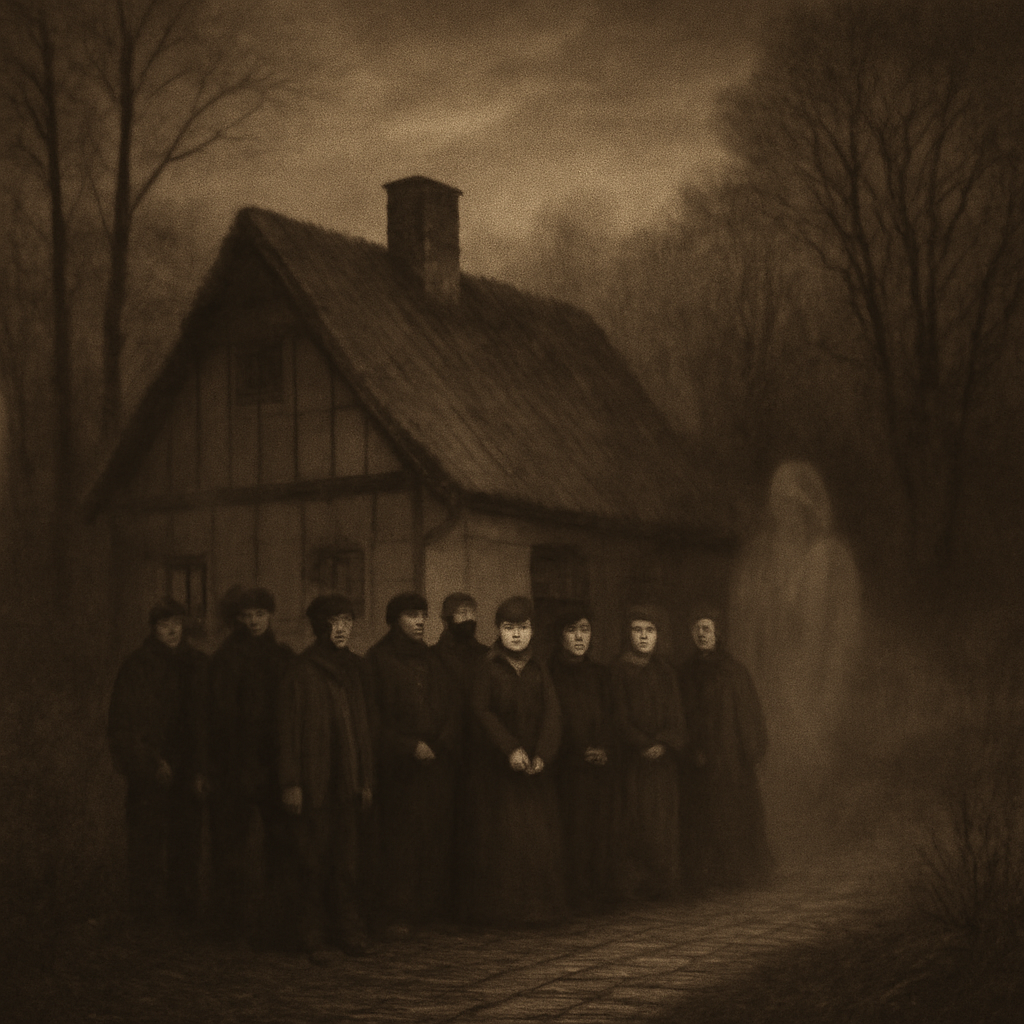
Neuendorf revealed itself beneath a dusk so lingering and heavy it seemed as though twilight had taken root and resisted the dawn—a dusk that stretched eternal, suffusing the sky with a spectral, leaden calm. This hour, suspended between day and night, was when the villagers gathered to be immortalised on a single, now crumbling, photograph. The photograph is my curiosity, and my burden.
The image, sepia-toned and faint with age, is framed in cracked walnut wood, etched in a modest script with the year 1871. Upon its worn surface stand a dozen or so individuals, most clad in somber attire befitting the solemnity of the day and place. Yet, on closer inspection, there is one presence that confounds any natural explanation: a thirteenth figure—transparent and faint, barely more than a shadow, yet unmistakably human.
This spectral personage does not echo the countenance or attire of the others but appears as a mournful apparition, suspended in a liminal state between the corporeal and the ethereal. Unlike the others who look directly into the lens with quiet dignity, this figure gazes beyond, as if ensnared in some eternal lamentation.
Attempts to account for this anomaly by way of double exposure or trickery betray the era’s nascent photographic technology, which, even in its inception, was far too crude for such spectral layering. The villagers themselves spoke little of the photograph, as though mindful that naming the ghost might invite its presence to walk again amongst the living.
Neuendorf’s own history, pieced together from fragmentary oral tradition, recounts a plague that struck the village in the previous decade, decimating families and casting the settlement into a veil of sorrow. It is whispered that the phantom in the photograph is the village’s black sheep, Gustav, who vanished on the eve of the plague’s visitation whilst walking the cornfields beneath this same eternal dusk. Some say he harboured a curse or carried a sin too weighty, condemned to linger unseen between mortality and oblivion.
Exhumations in the village churchyard yielded no record of Gustav's resting place, and the villagers’ eyes darken at mention of his name. It is as if he has become less a man and more a shadow that refuses to recede—a presence unwilling to traverse the boundary of this mournful twilight.
This photograph, found concealed beneath floorboards in the abandoned schoolhouse, therefore stands as a haunting testament: not merely a frozen moment in time, but a portal to a grief that refuses to dissolve. The anomalous figure embodies the vehement refusal of some souls to depart from their earthly haunts, stirring unease whenever the dusk prolongs, long after natural law would bid it yield.
In closing, I lodge this note in the hope that some future hand, rooted amidst a past still steeped in darkness, may contemplate the persistence of memory and spirit woven through Neuendorf’s vanishing light. That this solitary phantom, forever caught in the gaze of the camera, remains a silent witness to a vanished village and the secrets long kept beneath a dusk everlasting.
Signed,
An Anonymous Correspondent