The Silver Compass of Güstrow Manor
A melancholy relic found amid Baltic mists and whispered secrets.
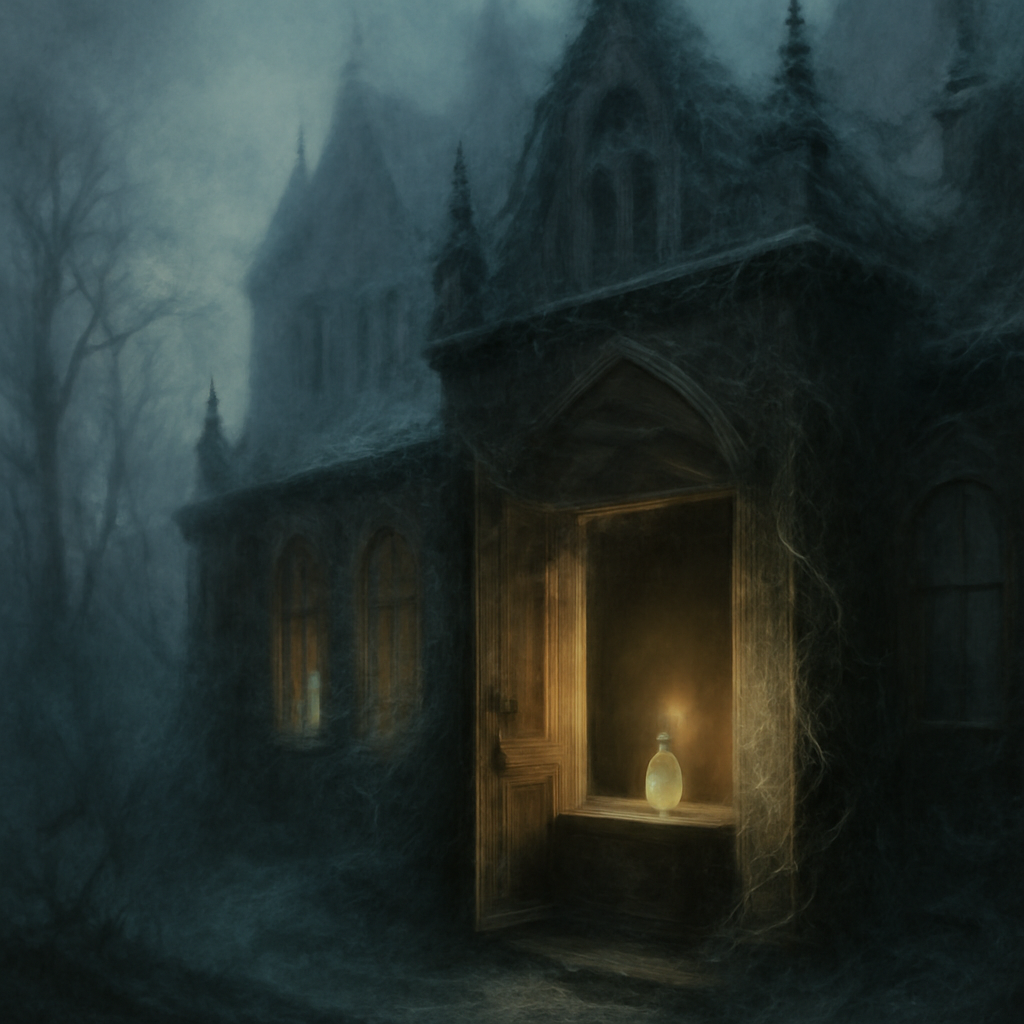
Journal Entry: December 1893
Whilst journeying through the frostbitten wilderness of East Prussia, my steps led me—quite by chance—to the deserted estate known only in faded maps as Güstrow Manor. The air was thick with winter fog, the pallid light of a sun hidden beyond grey veils doing little to vanquish the oppressive stillness. It was on this mournful day, an expanse of silence unbroken save for the distant call of a lonely crow, that I, a retired captain of the Imperial Navy, encountered a curiosity most strange and ineffable.
The manor itself stood like a spectre of time, its once-grand façades crumbling beneath creeping ivy and frost’s cruel hand. Windows gaped like hollow eyes, and the brittle bones of frozen branches scratched against the decaying walls. Within this mausoleum of grandeur, amid dust and desolation, I discovered a chamber sealed by a heavy mahogany door. Forced open by a hand trembling with both chill and trepidation, revealed was a modest chest, and therein lay the object of my reverence—a silver compass, tarnished yet exquisitely wrought.
Its needle was peculiar, for it did not align with the natural magnetic poles but instead quivered erratically, sometimes orienting towards compass points that defied earthly geography. Upon the back, a minuscule engraving bore the inscription “Vita in Tenebris,” Life in Darkness. This phrase seemed less an epithet and more a portent. The compass imparted a subtle, melancholic fervour, as if aware of unseen realms or lost souls wandering beneath the Baltic mists.
I reflected on the chronicle of Güstrow Manor, whispered among local peasants and sailors I once commanded—tales of vanished heirs and forbidden rites conducted in moonlit chambers. This compass, a mariner’s device transformed into an arcane oracle, spoke silently of voyages not merely by sea, but through dimensions unknown, perhaps bound to the restless spirits that lingered within the manor’s spectral walls.
The winter fog deepened, enveloping the manor and myself in its cold embrace, and it was with a pang of resignation I left the compass behind, for it seemed both an artifact and a burden—too potent for one mortal soul. Yet, even now, as the firelight wanes in my quarters far south from those haunted shores, I feel the persistent ache of that compass, its spectral needle forever pointing towards melancholy horizons lost to time.
Notable Observations
- Location: Güstrow Manor, Baltic coast, East Prussia.
- Object: An antique silver compass with unearthly directional properties.
- Weather conditions: Heavy winter fog, limiting visibility and swallowing sound.
- Year: Recorded explicitly in the late autumn of 1893.
- Character: A retired naval captain, whose military past lends authority to his testimony yet whose isolation in old age reveals a fragile credulity.
- Mood: Overarching melancholy, highlighted by ruin, spectral suggestions, and the somber atmosphere of abandonment.
These entries appear in the captain’s travel journal—part log, part confessional—a poignant narrative capturing a moment when earthly navigation and supernatural mystery entwine beneath Baltic twilight.