Echoes in the Dark Void
Field notes from Lunar Survey Camp Sirius, 1956: the Geiger counter clicks – but who, or what, is signalling back?
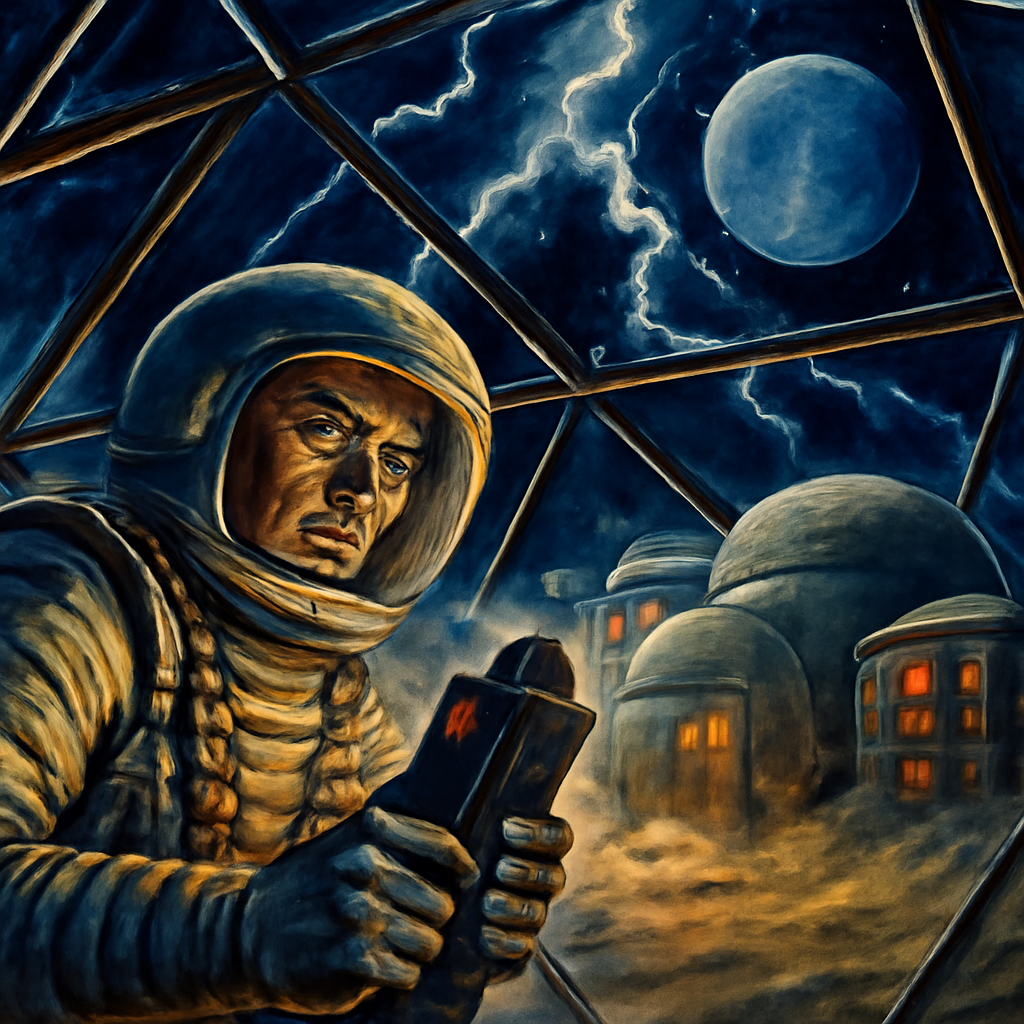
Lunar Survey Camp Sirius: Field Observation Report, July 15th, 1956
Observer: Test Pilot Captain Gerrard T. Kline
Location: Survey Outpost Theta, Sea of Tranquillity, Moon
The camp is no more than a cluster of aluminium domes and blinking instruments, pressed against the lunar dust and the eternal black silence of space. I can see the Earth hanging distant in the black sky, serene yet unreachable. Our routine survey day began as predicted; instruments hummed, and my trusty Geiger counter, a new Atomic Signal Model 3X, lay by my belt ready for any anomaly.
At first, the readings were dull and uneventful—just the weak background radiation typical of the Sea of Tranquillity. But before noon, the sky darkened unexpectedly. The latest in lunar meteorological theory hadn’t prepared us for this; an electrical storm. Flickering bolts of bluish arcs twisted and writhed across the black lunar horizon—an impossible sight to the untrained eye. We’re accustomed to vacuum and silence, but this moonstorm stalked us like an unholy tempest, flashing its fury against the horizon’s stark craters.
In the claustrophobic confines of Camp Sirius’s central dome, I watched the meter suddenly leaping—rapid clicks broke the steady tick, a rhythmic Morse pattern that felt almost… deliberate. Suddenly, the Geiger counter was no mere radiation detector. It was a cosmic telegraph.
The Signal
Every ten seconds, the clicks appeared in a sequence I couldn’t ignore. I jotted down the pulse sequences—a bizarre, alien staccato amid the thunderous crackle of lunar lightning. Surely, this must be error, some interference from the ionised plasma above? But the clicks persisted stubbornly and steadily as if attempting communication.
Is the Moon itself alive? Or have I stumbled upon an extraterrestrial mind tuning into our fragile presence here? The counter clicked a chilling rhythm:
- Dot-dot-dash—repeated again and again.
- Moments later, dash-dot-dot-dot, as though responding to a code only it understands.
My heart raced with the weight of not just discovery, but sheer unnerving alien contact. The dome’s walled steel pressed closer; each breath cycled with the hiss of recycled air. Even the electrical storm seemed to shake the fragile framework of our outpost, tightening the cage around us.
Field Impressions
- Test pilot here at Camp Sirius is no longer just a man observing statistics; I feel like a lone cosmonaut in a silent cosmic whisper chamber.
- The storm's electrical bolts sketch ballets across lunar plains, implying some deep, invisible force at work beyond scientific comprehension.
- The Geiger counter's Morse code is the strangest companion, broadcasting unintelligible riddles.
- Earthlight barely penetrates the dome’s viewport as tension coils tight in this sealed cocoon—claustrophobia makes every shadow sinister.
Should I alert Command? This signal might be the birth of a new space-faring comradeship – or a sinister lunar trap. The Geiger counter’s clicks persist into the eternal night of the moon, echoing secrets I may never understand. But one thing is certain: our lonely outpost’s isolation has, at last, been broken by the voices of the void.
Captain Gerrard T. Kline, logging final notes. Awaiting further instructions – though I already feel the moon watches back.