The Rainbound Ledger of Dunkelwald
A fragment from the diary of a theology student lost to a village absent from all maps in 1871
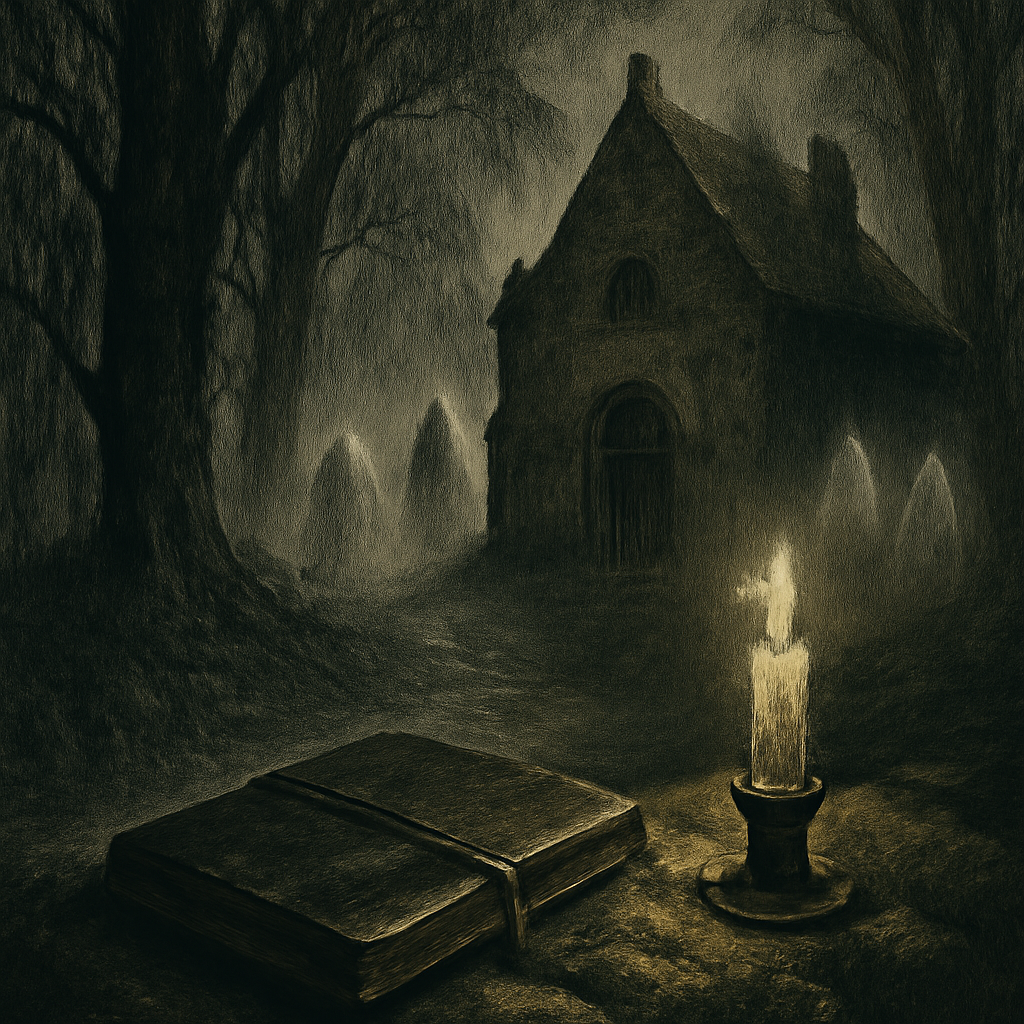
Diary Fragment, October 14th, 1871
Dunkelwald, a village forgotten by cartographers and cloaked in a persistent, weeping sky, folds itself between the dense shadows of ancient oaks and bracken that clutch the East Prussian earth. The rain has fallen uninterrupted for thirty days and nights, as if the very heavens are mourning a secret too grievous for disclosure.
Amidst this unyielding damp and gloom, I, Friedrich Albrecht, theology student at Königsberg, found myself ensnared not merely by geography but by something ineffable that dwells beneath these sodden woods. A curious object, a black notebook, surfaced at the heart of Dunkelwald’s abandoned chapel — a relic coated in ash-black leather, weathered but untouched by time's full decay.
This ledger, bound by a twisted cord of midnight sinew, bore no inscription save a single word upon its cover: Verloren — "Lost." Opening it revealed a sequence of entries in a hand both trembling and precise, as if by a scholar wrestling with faith and dread alike.
The first page reads thus:
- "The forest whispers truths in tongues fractured by age; no map shall claim these fields, for Dunkelwald has slipped beyond mortal reckoning."
- "Nearly a fortnight within this rain-blotted realm, and I sense shadows not cast by earthly branches—an otherness at the edge of sight, evading the prayers I clutch like talismans."
- "My studies of the Holy Scriptures betray me here, where fallen angels might yet linger, mournful and unredeemed."
The notebook’s further entries weave a narrative of spectral encounters and nocturnal vigils beneath the shuttered belfry. It speaks of a bell that tolls when no hand moves its clapper; of figures robed in twilight who trace silent processions through the mire, their faces obscured yet palpable. Each page stirs a melancholia thickened by the drear rain — a nostalgia for faith’s certainty now eclipsed by creeping doubt.
Tonight, as I reproduce this fragment by candlelight within the guestroom of the village's lone inn, the ledger’s presence presses upon me: an emblem of lost lore, a testament to the inescapable melancholia of knowledge pursued in shadow. The rain persists—a dirge for Dunkelwald and all who vanish beneath the shroud of forgetting.
May this record, sealed into ink and memory, serve as a lantern to those who, like me, wander the borderlands of belief and oblivion, yearning to grasp the intangible threads of a forsaken world.
Friedrich Albrecht