The Midnight Chronicles of Marienburg
A historian's private letter upon discovery at the Teutonic watchtower ruins, winter 1847
Marienburg, 19th December 1847
Esteemed Herr Friedrich,
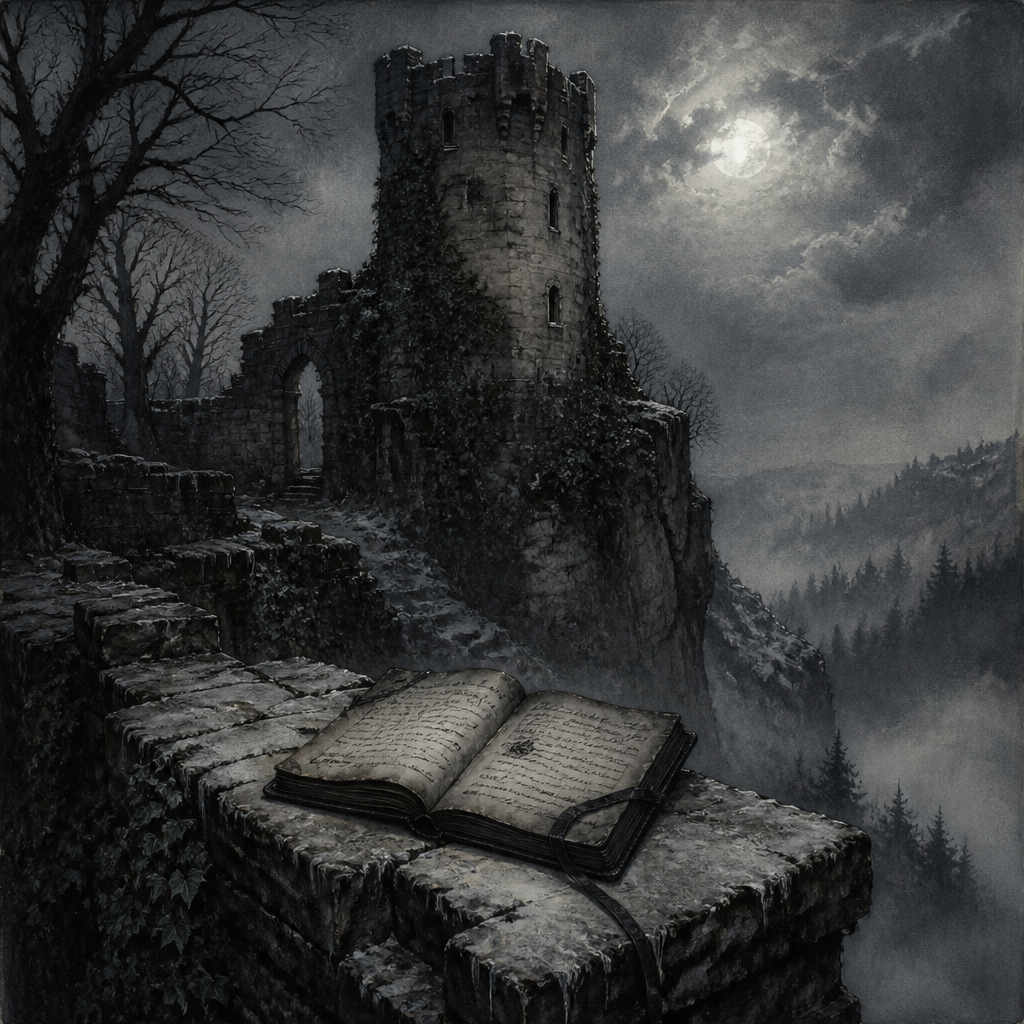
It is with a trembling hand and an unsettled mind that I pen this missive by the flickering light of my study’s dying candle. Earlier this week, as a thick and clammy fog enshrouded the crumbling remnants of the Teutonic watchtower on the northern escarpment—a sentinel long forsaken to ruin and whispered legend—I laid eyes upon an object most singular and disquieting: a black notebook, its leather cover worn yet impervious to time’s decay.
The watchtower itself stands as a spectral monument, its jagged silhouette clawing at the winter heavens, obscured beneath a veil of frost and mist. The air was pungent with the cold breath of the Baltic Sea, and each footfall upon the dank stones echoed like a dirge. I ascended the shattered stairs to the chamber where history’s shadows seemed thickest; here, between fallen beams and the stony litter of forgotten sentinels, I found the notebook.
This volume—bound in black leather, devoid of title or maker’s mark—exudes an aura uncanny and hypnotic, as though it were no mere repository of ink and parchment but a talisman aglow with vestigial power. The pages within are yellowed and brittle, yet penned with a certainty and clarity that belies their age. The script is of a cramped, almost spidery hand, the ink a lamentable shade of midnight, almost as if inscribed under the impalpable gaze of some mournful spectre.
Within these pages are strange chronicles and arcane meditations—fragments of lore not found in our annals, speaking of eldritch rites performed beneath a pallid, ghostly moon and secrets entrusted only to shadowed brethren of the Order long fallen from grace. They speak, too, of dreams not of the living but of those who have yet to come, their whispers trembling like the decay of the watchtower itself.
It is as if the notebook is less an artifact than an echo; a dream captured upon vellum, resurgent across the divide of years and memory. Amongst the entries, one passage chilled me profoundly:
"When the fog is thickest, and the bells toll not, the watcher awakens—not in flesh, but in shadow—surveying the ruins for what must not return."
I have since resolved to keep this journal in careful custody, for with it comes a burden of uneasy knowledge and a gnawing unrest that settles deep within the soul. Already, I find sleep scarce and haunted by dimly glowing runes and whispered songs from the edge of waking.
Know that I am compelled by a force beyond mere antiquarian zeal to delve more deeply, though I dread what further revelations may lie veiled beneath the winter’s pall.
Yours in solemn pursuit,
Anton Weber
Local Historian and Chronicler of the Teutonic Lands