Ghosts of Gare Junction
Black-market ID cards flicker like neon phantoms in the static fog of 2038
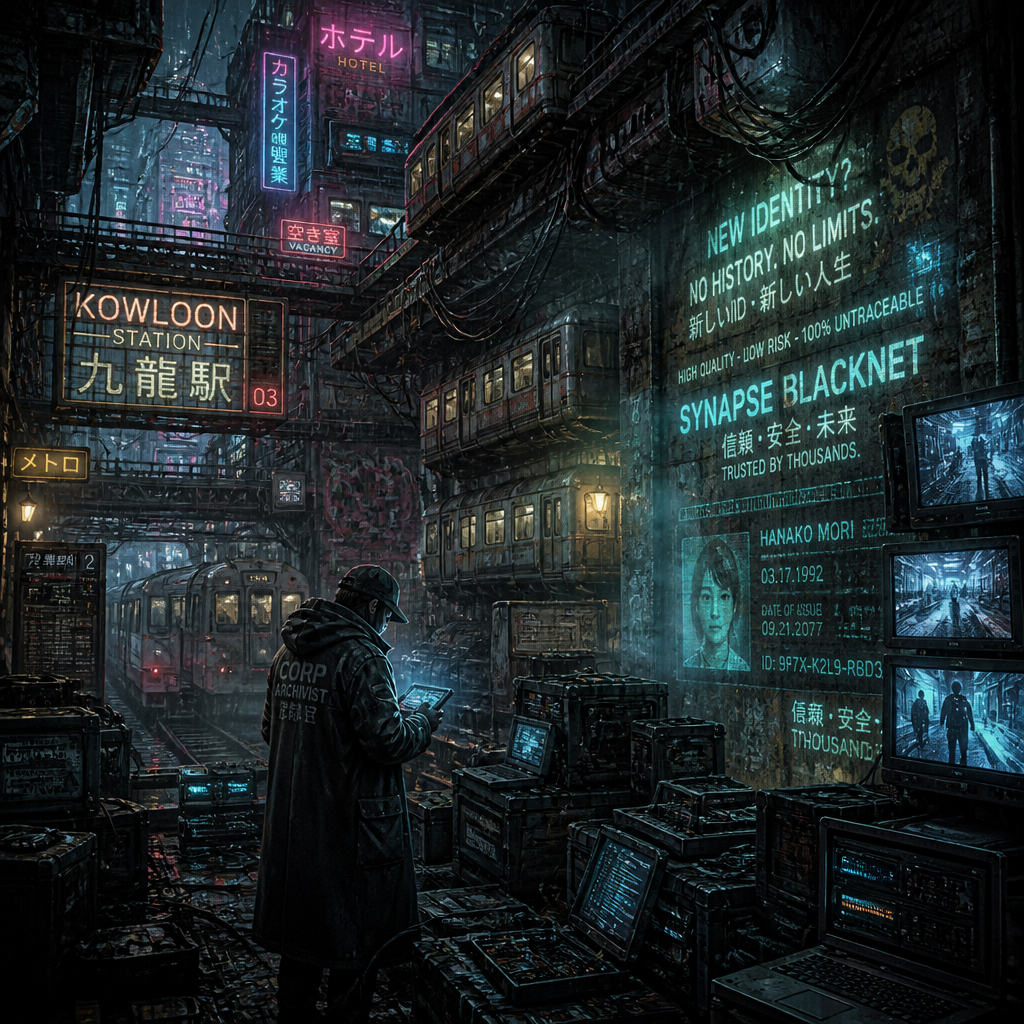
Gare Junction: The Vertical Maze
In the spiralling chaos of Gare Junction—the derelict railway station that once pulsed with the lifeblood of the city—an architectural corpse is kept alive by layers of rusted steel and patched neon. By 2038, this vertical slum has become a towering labyrinth of scavenged habitation modules stacked with reckless disregard. Each floor clings to the bones of obsolete infrastructure: vapour-streaked tunnels, graffiti-scorched railcars converted into micro-dwelling pods, and crumbling platforms draped in coil after coil of weathered wiring.
The air is thick with static-charged fog that never relents, a persistent synthetic mist born from malfunctioning plasma streetlamps and the humming residual of centuries of forgotten train engines. Moisture collects on every surface, blending with grime and the oily runoff of fifty-year-old trans-scramblers, now gutted and repurposed as data dumpers for the streetwired.
Counterfeit IDs: Paper Shadows in Neon
Among the dozen black-market stalls that stack like shanties into the gritty corners of Gare Junction's mid-level alleyways, counterfeit identity cards wrinkle under fluorescent flicker. These artefacts—half analog, half digital—aren’t just documents; they are talismans designed to slip through corporate databanks like whispers.
Each card integrates obsolete holochips, their internal circuits fried to mask true provenance. The holographic images twitch ‘alive’ for a few seconds, trapping flickers of forgotten faces before fragments of corrupted animation dissolve into static blankness. They are sold as untraceable keys into the monolithic towers of corporate power where surveillance is a myth, but memory is a weapon.
Advert for the Dispossessed
The black-market advert, sprayed on rusted walls with phosphorescent ink, reads like a siren's call to the desperate:
- "Need a new face? Slip the data-veil. Gare Junction ID cards: guaranteed to scramble corp scans, fade from data ghosts."
- "No digital tails. No legal qualms. Full biometric override—exclusive to 2038 model, crafted in the heart of the Fog."
- "Prices start at 45 creds. Payment via untraceable crypto. Meet at the #47 platform pod, market runs dusk till static dawn."
This advert, half fading into chipped concrete and scraped paint, glows dimly beneath overhead power cables buzzing with unpredictable surges. The precision of its words suggests a mind intimately acquainted with corporate security archives and the vulnerability of their once-impenetrable walls.
The Archivist’s Shadow
Among the shadows moving through Gare's claustrophobic vertical veins is Jensen Cain, a corporate archivist from Obelisk Systems, whose daily browse of shredded logs and corrupted nodes keeps him tethered to secrets no one dares openly claim. To the corporate world, he is just another silent curator of decaying data; in the underbelly of Gare Junction, his name is whispered as the man with access to unfiltered truths buried under layers of quashed surveillance footage.
Jensen’s expertise means he understands the counterfeit ID cards more than most: every forged hologram, bio-sequence, and encrypted barcode tells a story of desperation, of those erased from official history by the omnipresent gaze of mega-corporations. Yet, his complicity is ambiguous. While he occasionally feeds off the street networks—interested in the data ghosts that these black-market IDs leave behind—he is also bound by memory and contract to safeguard the corporate narrative.
His apartment, wedged between rust and flickering neon, is lined with disassembled terminals, salvaged biometric scanners and stacks of archaic hard drives, all humming quietly beneath the static fog that seeps in through broken windowpanes. Here, Jensen decodes the ephemeral identities of his customers, tracking the digital shadows borne by counterfeit cards—fragments too unstable for either official archives or street syndicates.
Static-Charged Fog and Forgotten Tracks
The fog itself becomes an actor: a living, crackling presence interfering with surveillance drones that buzz erratically overhead like cicadas caught in static storms, cameras with fragmented fields of vision, and brittle communication lines scratching out intermittent signals. It turns the station into a claustrophobic maze where every step could summon digital spectres of forgotten identities, data ghosts trailing behind the counterfeit customers.
Records are unreliable here. Obsolete machines that once catalogued travellers are now tombs of lost metadata, corrupted beyond repair and relying on scavenged archives like Jensen’s to restore broken links. The corporate fix is always partial and selective, leaving the vertical slum a repository of fractured histories—an ecosystem where black-market identity cards flicker as fragile lifelines.
A Fragment of Time and Place
In Gare Junction’s decay, neon signs advertising impossibly cheap fixes and corporate lies bleed into one another beneath broken glass and puddles shimmering with oil and light. It is a place where the desperation of the dispossessed meets the cold indifference of towering corporate monoliths. The counterfeit identity card is not just a tool; it is the embodiment of a fractured society—where thriving means fading into the static fog, leaving behind only data ghosts and whispered rumours.