The Ember of Selene Base
A 1952 mission report on the eerie discovery of a miniature star trapped within a glass sphere on a forgotten lunar outpost.
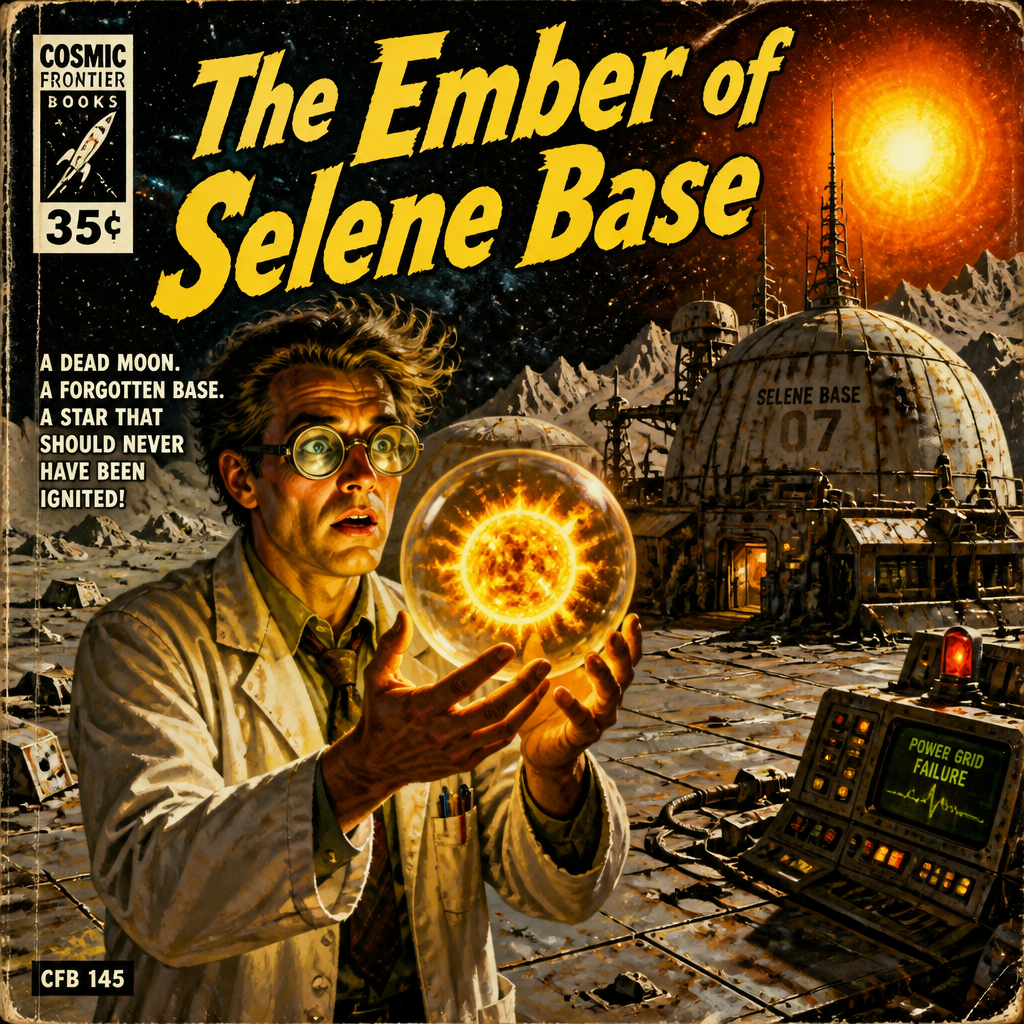
Mission Report on Selene Base Anomaly
Date: 17 July 1952
Location: Selene Base, Moon Outpost Delta-7
Reporting Officer: Commander James Cartwell, Lunar Survey Division
In the dry desert heat of the lunar surface—strained under the relentless glare of Earth’s distant blue shimmer—Selene Base stands abandoned, a skeleton of gleaming metal and long-forgotten ambition. Originally constructed in the frantic scientific enthusiasm of 1949, it was meant to be a beacon for peaceful exploration but swiftly became a monument to mystery and caution.
Our mission was straightforward: inspect the base for salvageable data and ensure no hazardous materials were left behind. Selene had been silent for over two years, ghostly in the stark glare of the sun and the deep shadows of the craters. Yet as our team breached the airlock, a strange sensation gripped us—an uncanny warmth in an environment colder than the void itself.
Central to this report is the discovery made in the main laboratory by Dr. Theodore Vance, a brilliant but notoriously reckless scientist who insisted on staying behind the initial clearance protocols. Amidst overturned instruments and dusty control panels, Vance uncovered the Ember Orb: a palm-sized glass sphere housing what appeared to be a miniature star, radiating soft golden flames that pulsed with a heartbeat-like rhythm.
The Ember Orb’s Characteristics:
- Dimensions: 8 cm diameter, perfectly spherical, seamless aged glass.
- Internal Phenomenon: Intense, living starfire emitting controlled solar flares on a minuscule scale.
- Thermal Output: Paradoxically warm to the touch yet causing no damage to immediate surroundings.
- Temporal Behaviour: The microflame’s rhythm synchronized oddly with lunar day-night cycles, though it remained unconcerned by Earth’s hours.
Dr. Vance’s log entries reveal his obsession. He hypothesized the Ember Orb was a failed project of Selene’s former scientific chief, designed to contain stable fusion energy in a self-sustaining loop. Yet, bafflingly, the orb exhibited behaviour that defied known physics—its flames did not consume fuel, and its light bore properties neither reflected nor easily absorbed.
The atmosphere within the base grew unsettling. Energy readings fluctuated unpredictably. Electronics shimmered with interference through ancient wiring. The orb’s glow cast long shadows, transforming the sterile lab into a hazy theatre of cosmic wonder and latent peril.
Notably, Dr. Vance disregarded strict warnings, carrying the orb through the base corridors unshielded. His notes become erratic after this; entries detail vivid dreams of distant suns and alien skies, a chorus of whispers seemingly emanating from the Ember itself.
On the final day of our inspection, Vance claimed the orb called to him—not in words, but by a force that tugged at his very mind. Suddenly, the orb’s inert containment shifted: miniature solar flares blazed forth, vibrant and alive. A brief but fierce thermal surge swept the base before he managed to contain it once more, his face etched with both exhilaration and fear.
It became clear the Ember Orb was more than an energy source—it was a cosmic enigma, perhaps a fragment of an alien cosmic engine or an embryonic star birthed by unfathomed universal forces. Attempts to remove it from the base resulted in inexplicable phenomena: gravity distortions, flashes of non-linear time, and inexplicable echoes of voices from beyond.
Summary and Recommendations:
- Selene Base must be quarantined until further study can safely determine the Ember Orb’s origin and containment needs.
- Dr. Vance requires psychological evaluation to assess long-term exposure effects.
- Research into controlled miniature stellar phenomena should proceed with extreme caution, acknowledging the uncanny nature of the Ember.
- The orb may represent a breakthrough in energy generation—or a perilous intersection with otherworldly forces that humanity is not ready to face.
The lingering heat of lunar noon and the whispering shadow of the Ember leave us with more questions than answers. What began as a routine salvage operation has become an encounter with a living mystery, glowing quietly in its glass prison, holding secrets older than the oldest stars.
End Report.