The Mask of Abendrot
A Theology Student’s Account of an Unearthly Calm in a Waning Day
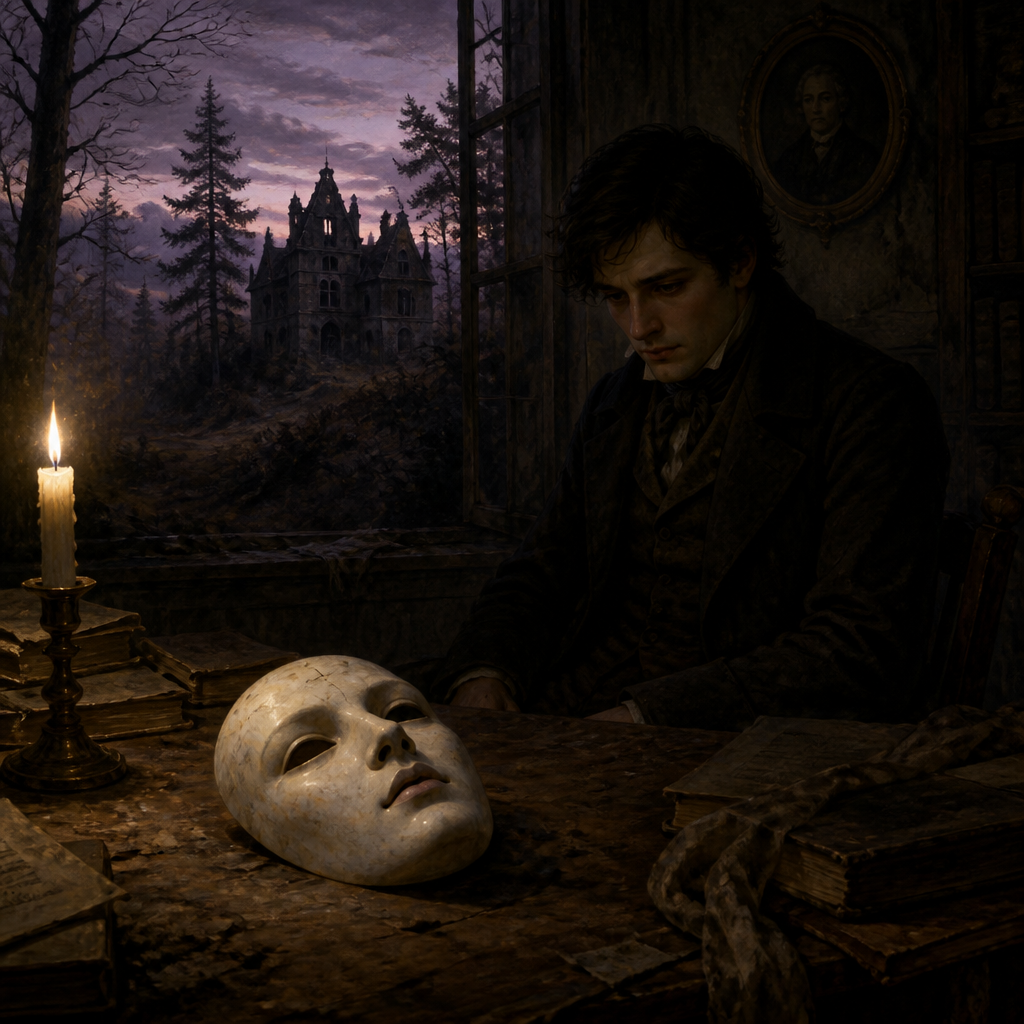
A Strange Report from the Forlorn Lodge of Grautenwald
On the eve of the 17th of October in the year of our Lord 1871, under a dusk that seemed to linger beyond all earthly measure, Herr Wilhelm Lenz, a student of theology from Königsberg, set upon what was meant to be a brief expedition to the decaying hunting lodge of Grautenwald, nestled deep within the shadow-haunted borderlands of East Prussia. His purpose was ostensibly scholarly: to gather meditations upon solitude and the silent mysteries whispered by the dying woods. Yet what he discovered was a solace both unnatural and profoundly disquieting.
It was under such a sky, a vast yet muted firmament shaded with bruised purples and clotted greys, that the lodge breathed its last mournful sighs of an age long surrendered to ruin. The brittle door wept in the wind’s sibilant lament, and the stone hearth lay cold—save for the strange warmth that seemed to emanate from a single object upon the dust-laden table.
Here, amid the ruin and the creeping ivy that sought to reclaim human handiwork, the theology student discovered a cracked porcelain mask. Its alabaster surface, once alabaster, was now flecked with the patina of neglect. Yet the cracks formed not fractures of violence, but of a careful, deliberate splitting—as if time itself had sought to rend but could not destroy the visage beneath.
The mask was curiously serene. Eyes hollow but softened, lips parted faintly as if upon a secret breath, and the curve of the cheeks rendered with an artistry that evoked not fear or mirth, but the quietude of an eternal dusk. The very sight of it induced a tranquil languor, a strangely peaceful surrender to the lingering day that refused to fade completely.
Herr Lenz recounted in his journal:
- “As twilight stretched endlessly above, the lodge shut away the noise of the world. Then, drawn inexplicably to the mask, I felt the ceaseless unrest of youth and doctrine slip quietly from my shoulders.”
- “The air grew dense with a gentle stillness that was neither life nor death, but a breath held between both in supplication.”
- “It is a beauty that transcends all earthly adornment, yet is marked with the melancholy of something ancient and undying.”
It is said among the townsfolk of Grautenwald that the lodge was once the hunting retreat of a reclusive nobleman versed in the occult, who vanished without trace in the days before the Franco-Prussian War. Rumours speak of guests who wore masks to commune with spirits, exchanging their own souls for glimpses of the ineffable. Whether this cracked porcelain visage belonged to such an one remains a matter for conjecture; the very air about the lodge seemed to suggest that the mask was no mere artefact, but a vessel of suspended grace caught in the gloaming.
The report concluded with the student’s sober reminder to those tempted by the arcane:
“Beware the hour when day does not admit the night, nor night the day—therein lies a doorway best left unopened, and faces better left unseen.”
Thus ends the extraordinary account lodged within the Königsberg Gazette, a chronicle reminding us that some fragmentary relics of a lost East Prussian wilderness carry with them whispers not of dread, but of a placid abyss all the same.