The Shimmering Crystal of Luna Base 3
A nervous controller’s field report unveils an otherworldly marvel beneath the dusty plains of the Moon, 1952.
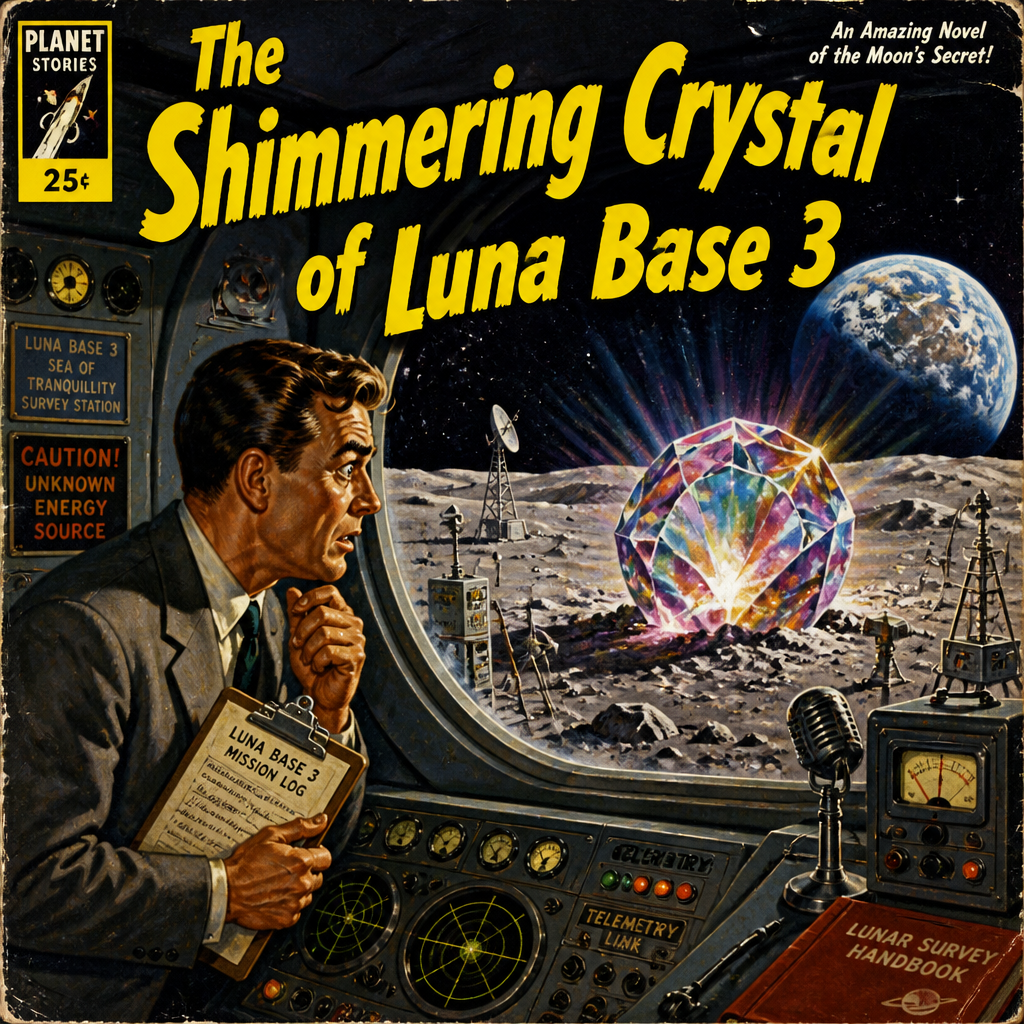
Lunar Survey Camp Observation Report - 17th July, 1952
Author: Charles T. Wentworth, Mission Controller, Earth Command Centre
Location: Luna Base 3, Sea of Tranquillity
Weather Conditions: Scorching desert heat equivalent on Earth, with relentless glare from the Earthshine and solar radiation.
Field Observation: The following report details the extraordinary findings recorded during the third day of the 1952 lunar survey expedition, currently underway by the United Earth-Stellar Exploratory Agency.
Despite the barren appearance of the Sea of Tranquillity’s endless grey dust, our team encountered an astonishing anomaly mere kilometres from our base camp: a meteorite fragment radiating an intense, almost hypnotic crystal glow. The fragment was discovered partially buried beneath the lunar regolith, emitting a dazzling light that defied all known earthly mineral luminescence.
The day's routine had begun under the familiar blistering heat, a condition simulated within the pressurised habitat, but supremely alien on our barren satellite haven. Commander Jonas Lark, exploring with the geologist Dr Maeve Sumner, first reported the site after their portable detectors registered an inexplicable energy surge.
Upon investigation, the fragment’s surface was neither metallic nor stony in any traditional sense. Instead, it resembled a translucent lattice of interlocking crystals, pulsating softly with a prismatic intensity that seemed to shift colour with each of the tiny lunar dust grains caught in its beam. It might have belonged to some distant, unknown asteroid or even an ancient alien artefact lost to time and space.
Back in the cramped command module, I sat tense and nervously adjusting the analogue dials — the old valves and flickering cathode signals— trying to capture the fragment’s spectral signature and broadcast it back to Earth. I confess, despite years of space mission coordination, a tangible shiver of unease crept up my spine at the thought that this object might be more than a mere rock.
The day wore on, and the relentless vacuum-stirred dust storms — though milder than those on Mars — whirled relentlessly through open equipment vents, a reminder of the unforgiving environment. Yet, amidst these conditions, our mood shifted from routine to reverence, eyes wide behind bubble helmets, spellbound by the meteorite's alien beauty.
Field Notes & Initial Hypotheses
- Crystal Structure: Unlike any terrestrial mineral, possibly of a silicon-aluminium composition unknown to our mineralogists.
- Light Emission: Emits a low-frequency electromagnetic pulse coinciding with the pulsations of the crystalline lattice.
- Surface Temperature: Ambient despite intense radiation filtering through metres of regolith.
- Nervousness of Mission Controller: Unexplainable; may be psychological response to the fragment’s inexplicable properties or premonition of undiscovered dangers.
I prepared a series of cautious experiments for tomorrows’ dawn cycles: attempts to refract the meteorite’s light through scientific lenses, electromagnetic field mapping, and potential thermodynamic interaction. Would this be the dawn of a new lunar era? Some cosmic key to unlock the vast mysteries of the moon or even the wider solar system?
For now, as I pen these final lines, the fragment rests in its special containment, humming softly, its eerie glow bathing our sleeping lunar camp as if warning us that beneath the harsh desert silence of space, wonders beyond imagination wait silently.
The wonder is palpable. The mystery, profound. And as the nervous mission controller, I confess, tonight the stars seem larger, and the Moon a stranger, more magnificent world than ever before.