The Spectral Countess of Windbühl Manor
A twilight visitation revealed in a photograph with one figure too many
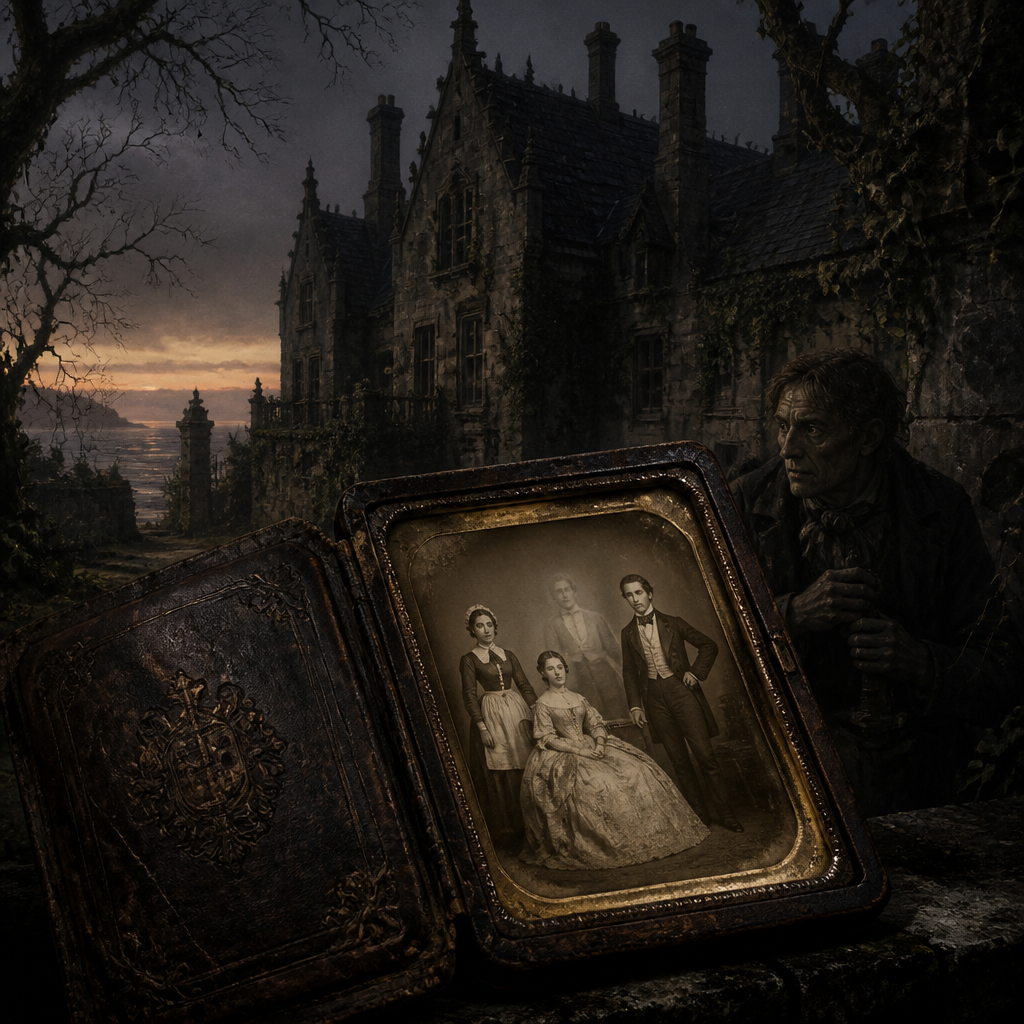
Extract from the Journal of Wilhelm Krause, Traveling Antiquarian – Autumn 1847
It was in the dusky gloaming of an unusually lingering autumn eve—one that seemed to stretch interminably between day and night—that I found myself before the ruined gates of Windbühl Manor. This once-proud estate, nestled in the misted recesses of East Prussia's Baltic border, has long since fallen into desolation. Yet there, amidst the skeletal remains of stone and timber, an uncanny calm reigned—a quiet that felt not like absence, but a peculiar kind of presence.
My guide and caretaker for the night was Herr Friedrich, a man of thin frame and twitching nerves, whose family had tended the manor's grounds since before memory could serve. He ushered me cautiously through the crumbled doorway, whispering of old tales and whispering shadows, his voice barely rising above the murmur of a wind too cold to bear the breath of living things.
"Monsieur," he confided in a tremulous tone as we entered the main hall, "be wary of the evening light. It stretches strangely here, as if time itself hesitates to proceed. The manor holds its own vigil, and the dusk lingers... longer than it ought."
Indeed, that evening the horizon seemed caught in an ethereal limbo, the sun's glow a stubborn ember refusing its descent. This prolonged twilight cast the manor’s shattered walls in hues of faded sepia, lending the crumbling edifice a semblance of faded grandeur and spectral grace.
Our purpose was to investigate a curious object recently uncovered amidst the manor’s neglected belongings: a daguerreotype, sepia-toned and oddly pristine against the decay, depicting the manor’s last mistress and her small retinue. The image was taken in the year 1847, inked forever in the immutable stillness of the plate. What made it a matter of whispered conjecture was the peculiar fact that, while the record and all known histories accounted for but three figures—the Countess, her maid, and a visiting nobleman—there appeared inexplicably a fourth shadowy form, standing behind the group, translucent yet unmistakably definite.
Herr Friedrich's knuckles whitened upon the frame as he recounted, "No one else was ever there, save those three. We have sought explanations, be they trick of light or frailty of the plate, but the apparition remains. I dare not say more—for to acknowledge it aloud is to invite its return."
Examining the photograph under my candle's flicker, I perceived the fourth visage—evasive yet chillingly certain. The figure was a woman, clad in the fashion of a bygone era, her gaze not towards the camera, but seemingly fixed upon some unseen sorrow. There was no malice in her expression; rather, an overwhelming serenity, as if she existed outside the tumult of mortal coil and haunted only her own tranquil grief.
That night, as the eternal dusk refused passage to midnight, Herr Friedrich retired to a corner of the hall, his vigil disrupted yet unwavering. I remained alone beside the fireplace, where the faint embers quivered as though breathing some ghostly life. The manor exhaled in silence and shadow; the air hummed softly with secrets long kept.
Upon my departure, the nervous caretaker pressed the photograph into my trembling hands with a faint smile—perhaps a benediction, perhaps a farewell. I am left with the spectral countess’s eternal gaze, and the knowledge that within Windbühl Manor, time lingers like a whispered prayer, and some presences remain, peacefully waiting beyond all reckonings.