The Drowned Ledger of the Alte Krone
An 1871 police report detailing the discovery of a mysterious black notebook in a flooded cellar beneath an East Prussian inn
Polizeibericht: Königsberger Kreis - 3rd February 1871
From the desk of Oberingenieur Heinrich Brandt, Königsberg
On the fog-laden morning of the 3rd of February, in the year of our Lord 1871, under the pallid shroud of a winter mist that cloaked the land like a raven’s wing, I was dispatched posthaste to the hamlet of Großendorf, nestled amidst the sodden lowlands of East Prussia. My orders arose from an urgent communiqué received the previous eve by the Königliche Polizeipräfektur, concerning an otherworldly occurrence within the flooded cellar beneath the venerable inn known as the Alte Krone.
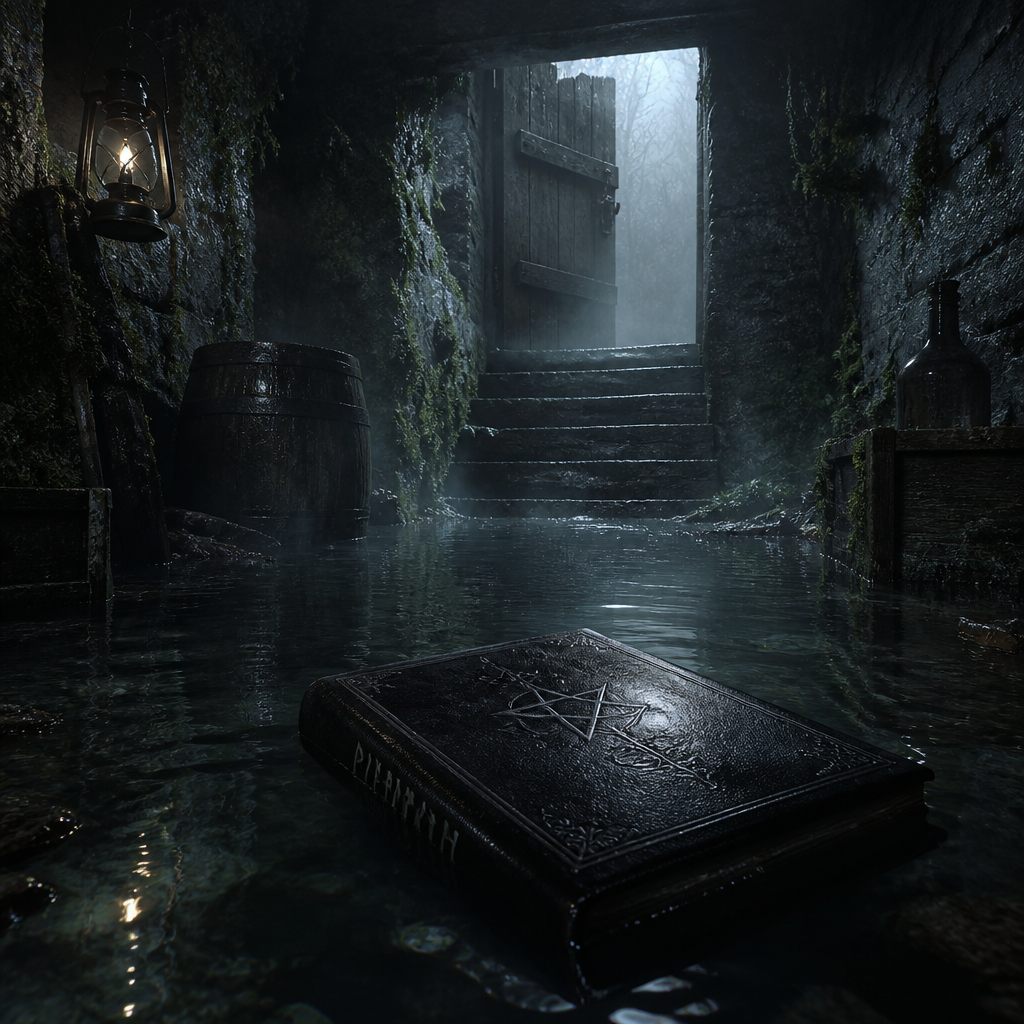
Local authorities had noted a curious calmness permeating the cellar’s waters despite the bleak tempest outside. What garnered suspicion was the report that a certain artefact - a black notebook of indeterminate origin - had been recovered from beneath the fetid floods that had rendered the storage vault unusable for the best part of a decade.
Upon arrival, the innkeeper, Herr Georg Müller, recounted how the unseasonable inundation began with the thaw of the frozen river that courses near the inn’s foundations, yet the waters within the cellar displayed no sign of ebb nor flow, as if preserved in a state outside time itself. He, a man neither prone to hysteria nor superstition, described a spectral stillness that befell the air and his limbs, likened to the embrace of a slumbering spectre.
My own approach to the cellar was unaccompanied but for a lantern, its feeble flame struggling against the oppressive gloom. The stairwell descended steeply into black water, and with careful footing upon submerged beams, I obtained the object: a small, leather-bound notebook, its cover of deep obsidian, unmarked save for a faint sigil embossed in silver - a twisting fern leaf entwined with arcane runes.
Extraction of the ledger was accompanied by a peculiar sensation: the air grew warmer, the oppressive chill of the fog seemed to retreat and a peace, almost reverential in nature, settled over the damp stone walls. There was no clamour of water; no hint the cellar had been flooded at all. The falling mist above the inn carried only the faintest whisper of a lament — an unvoiced elegy as old as the soil.
Preliminary examination of the notebook revealed pages alternating between meticulous technical sketches and cryptic annotations in a hand both foreign and familiar, blending the language of engineering with... other symbols, almost alchemical. The date in the frontispiece bore the year 1837, the hand of a certain Wilhelm Falkenhayn, an engineer of no small renown from Königsberg, whose disappearance in the winter of that year was never satisfactorily explained.
The ledger's technical drawings depicted devices of impossible design: contraptions blending steam mechanisms with esoteric sigils suggesting a knowledge beyond the mortal. It is posited that Falkenhayn’s final endeavour sought to harness the subterranean waters beneath the inn as a conduit for energies unknown, perhaps yielding his tragic fate and the lasting, inexplicable stillness.
Details Summarised
- Location: Flooded cellar beneath the Alte Krone inn, Großendorf, East Prussia
- Object: Black leather notebook with arcane embossments
- Date Discovered: 3rd February 1871
- Weather: Thick winter fog, still and enveloping
- Central Figure: Oberingenieur Heinrich Brandt, official inspector from Königsberg
- Previous Owner: Wilhelm Falkenhayn, engineer disappeared 1837
It remains the judgement of the undersigned that the ledger be preserved and subjected to further scholarly examination by the academic arbiter bureau in Königsberg, for the potential knowledge contained within may unveil both the genius and folly enfolded in the domain where man trespasses upon nature’s secrets.
The peaceful murmur of the flooded cellar is a silence most profound, as if the waters themselves guard secrets best left submerged, suspended beneath a veil of winter’s spectral breath.
Report compiled and submitted on the 10th of February, 1871.
Heinrich Brandt
Oberingenieur, Königsberger Kreis