The Luminous Shard
Mission report from Orbital Observatory Gamma on the baffling fragment that defied all known science.
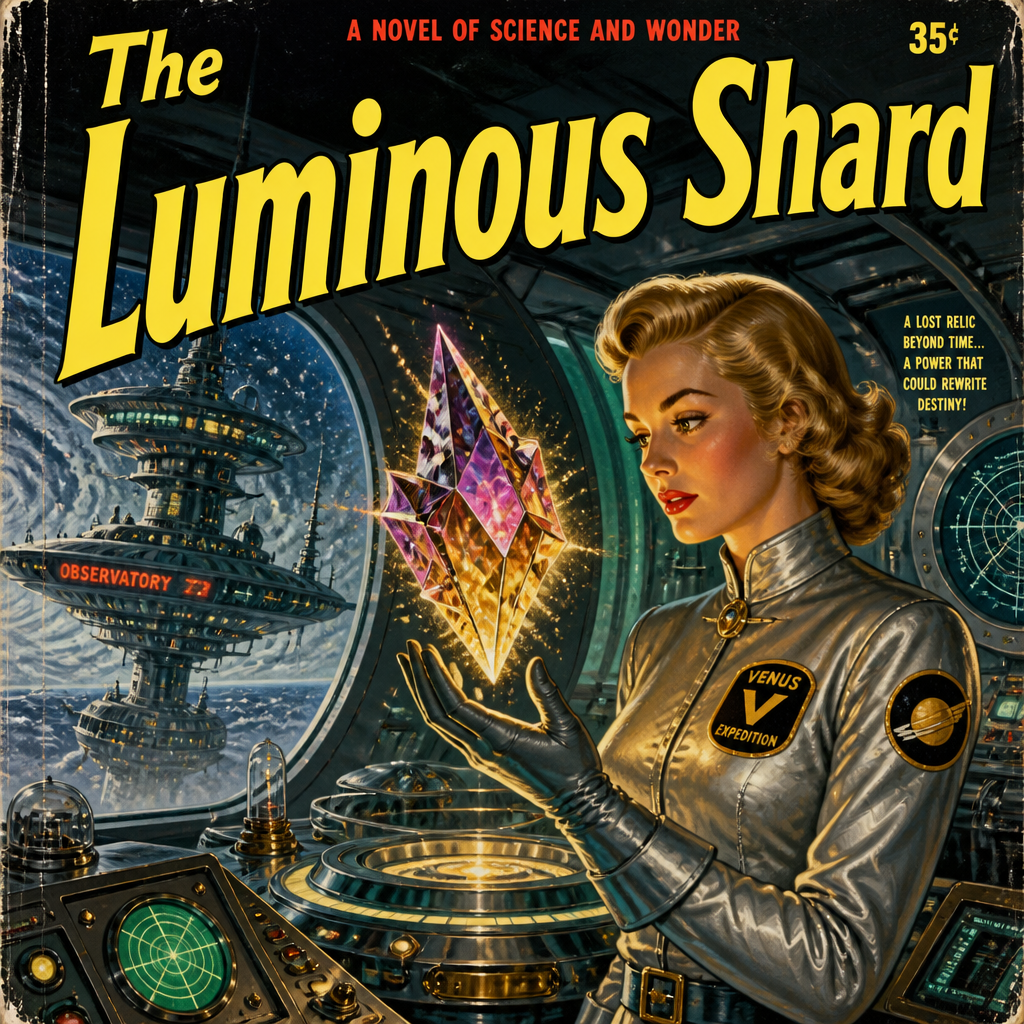
ORB-52 Mission Report: The Luminous Shard
Date: 14 November 1952
Location: Orbital Observatory Gamma, Earth Polar Orbit
Lead Officer: Commander Elara Trent, Venus Expedition Leader
Summary: The discovery of an impossible fragment metal within the icebound debris field of a disintegrated near-Earth asteroid has left the scientific community in polar whiteout confusion. Command module personnel under my supervision conducted preliminary analysis aboard Orbital Observatory Gamma, only to encounter properties beyond conjecture.
Our expedition to Venus last year, while fruitful in geological sampling, did not prepare us for the enigma now orbiting Earth itself. This report summarises events leading to identification of the ‘Luminous Shard’, its bewildering physical characteristics, and speculations on origin.
Discovery and Retrieval
On 7 November, Orbital Observatory Gamma’s long-range magnetographs detected anomalous electromagnetic disturbances emanating from the crater-laden shell of asteroid 1952 ZD. Initial scans confirmed a compact metallic fragment orbiting in a polar trajectory, tumbling slowly against the blizzard of space ice. Despite an intense polar whiteout beyond our viewport, maneuvering was conducted with precision piloted by Lt. Vidal.
The fragment recovered by remote claw was no wider than a clenched fist but radiated iridescent light—purple shifting through emerald and gold—without emitting detectable heat or radiation. The surface was smooth yet seemingly liquid, impervious to laser ablation or micro-probes.
Physical and Chemical Analysis
Initial spectrographic tests confounded every standard element known—a spectrum impossible to reconcile with the periodic table. The metallic shard showed zero magnetic permeability, infinite tensile strength, and a density fluctuating between lead and mercury on repeated measurements.
Attempts to cut, melt, or distort the fragment failed; X-ray diffraction showed impossible crystalline lattice geometries—patterns that shifted during observation, as if reluctant to be pinned down by mortal instruments. Repeated temperature swings from minus 150°C to chamber-busting 900°C yielded nothing but persistent luminous glow.
Theories and Speculation
- Extraterrestrial Artifact: Given the fragment’s proximity to a known asteroid carcass, it’s plausible to suspect alien origin, possibly remnants of advanced Venusian spacecraft lost or ejected during past solar storms. Venus remains largely mysterious, and our 1951 surface expedition scarcely scratched its veil.
- Time-Distorted Matter: Could the shard be a fragment from a future or alternative timeline, anomalously transported by cosmic rays or gravitational waves? This would explain its non-standard chemistry and temporal instability.
- Unknown Element or Alloy: Revolutionary theoretical physics predicts higher-dimensional metals, but no one has yet chanced upon a sample—until now.
Conclusion
Orbital Observatory Gamma remains in a state of collective fascination and scientific bafflement. The Luminous Shard challenges all our preconceptions about matter and energy. With Commander Trent’s previous experience leading expeditions into the Veiled Zones of Venus, we trust that further inquiry guided by her insight may unravel this mystery. However, at present, it stands as a luminous enigma against the frozen whiteness of space.
End of Report. Prepared by Lt. Captain S. Hawkins, Science Officer, Orbital Observatory Gamma.