The Vanished Hamlet and the Lacuna of Prayers
An archaeological note on a lost East Prussian village and its enigmatic prayer book, winter 1893
Introduction
In the bitter heart of winter, beneath a sky laden with sodden clouds and a relentless fall of heavy snow, I undertook a solitary journey into the wooded reaches of northern East Prussia. My purpose was to investigate a curious report of a village absent from all contemporary maps, a place whispered of in local taverns as Altes Geisterdorf—the Old Ghost Village. Said to have been forsaken many decades prior, its ruins promised secrets cloaked in solemn mystery.
Arrival and Setting
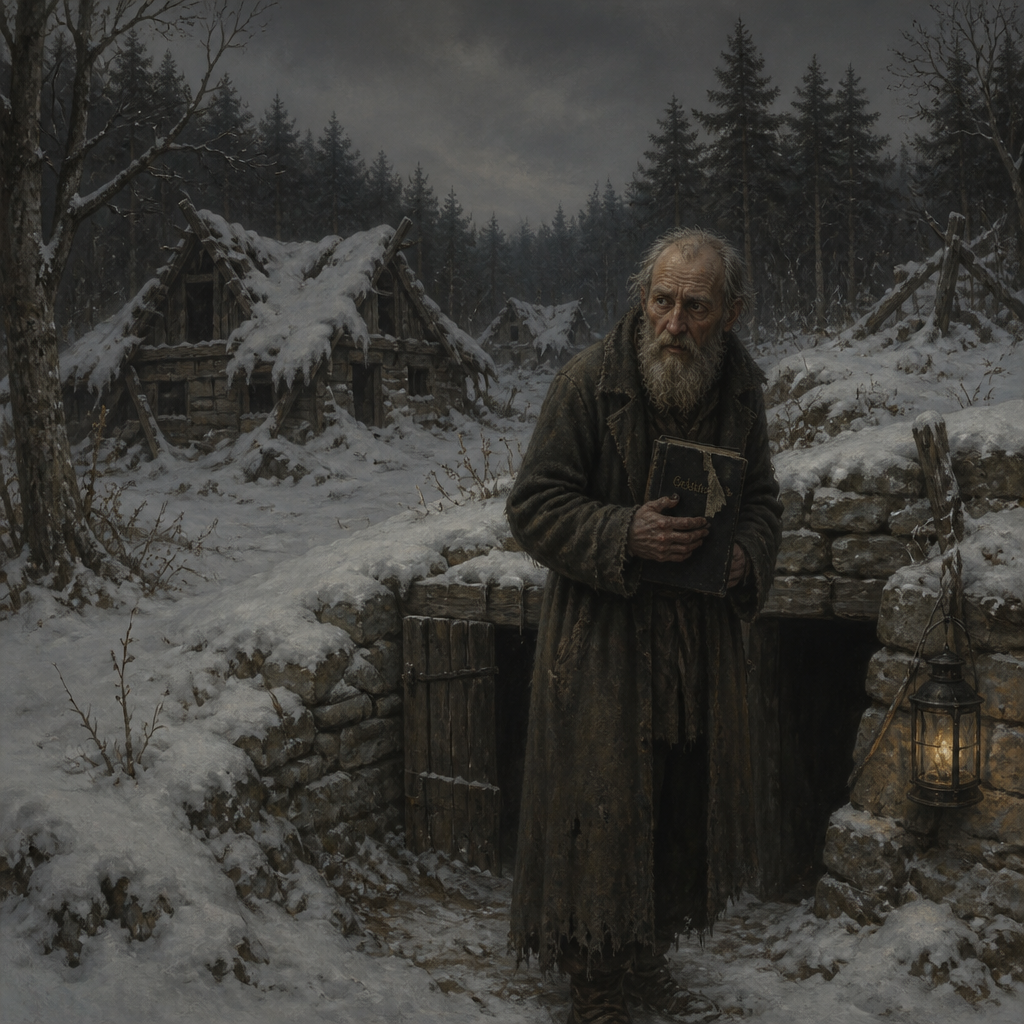
After days of traversing frozen bogs and brittle pine groves, I came upon a clearing blanketed in pristine snow. There, half-buried beneath drifts, lay the remains of half a dozen timbered cottages. Their charred beams and sagging roofs spoke not merely of neglect, but of a sudden and terrible calamity, now lost to time. The air was heavy with silence, save for the whisper of the wind among skeletal branches.
The Caretaker
As I gathered what artefacts I could, a sudden rustling from the treeline revealed a figure cloaked in threadbare wool—an elderly man, his visage wan and drawn, eyes darting as if haunted by unseen spectres. He identified himself as Johann, the nervous caretaker, though the village had not housed a living soul these many years.
Johann insisted on accompanying me, guiding my trembling fingers to a half-intact stone cellar beneath the largest cottage. Inside lay a wooden chest, its iron latch corroded but unbroken. Upon opening, we found a solitary object of singular interest: a prayer book, bound in worn black leather, its spine fractured, its pages yellowed and brittle with age.
The Prayer Book
The tome was evidently of ecclesiastical origin, likely dating from the early 18th century, inscribed solely in Gothic script. Its margins contained the faint traces of prayers scribbled in quill, some faded into illegibility. Yet, most curious was the conspicuous absence of one leaf, torn away with such violence that its neighbouring pages bore tears and ink smears in chaotic disarray.
Johann muttered that the missing page was no ordinary omission but a deliberate excision. According to local lore, the page contained a prayer not directed to God, but to something else—something ancient and malevolent lurking beneath the village’s soil. They spoke of a curse, a pact long forgotten, and a terrible price exacted in snowbound nights.
Mood and Reflection
As the snow deepened outside, and the old caretaker’s nervous glances grew more frequent, I was seized by a sombre unease. The absence of the prayer, the village erased from maps, the frozen desolation—they seemed no coincidence but parts of a portentous whole. Here was a place where the boundary between the holy and the profane had blurred, leaving behind a riddle cast in the frozen silence of an East Prussian winter.
Thus, I inscribe these notes not as mere academic curiosities but as solemn remembrance, a testament to a vanished place and an incomplete prayer that may yet hold some dreadful key to the village’s undoing.
Catalogue of Observations
- Village: Unnamed, located approximately 20 versts north of Tilsit but absent from official maps.
- Date of Visit: February 1893, during an unyielding snowfall.
- Key Artefact: A black-leather prayer book missing one page, apparently removed with intent and violence.
- Caretaker: Johann, an aged man exhibiting signs of profound nervous apprehension.
- Weather Conditions: Constant heavy snow obliterating landscape features, enforcing isolation.
- Mood: Solemn, tinged with an unspoken dread and respect for what has been lost.