Emerald Shadows on Xelphar VII
Field Observations from a Test Pilot Trapped Beneath Pluto's Unnatural Green Sky
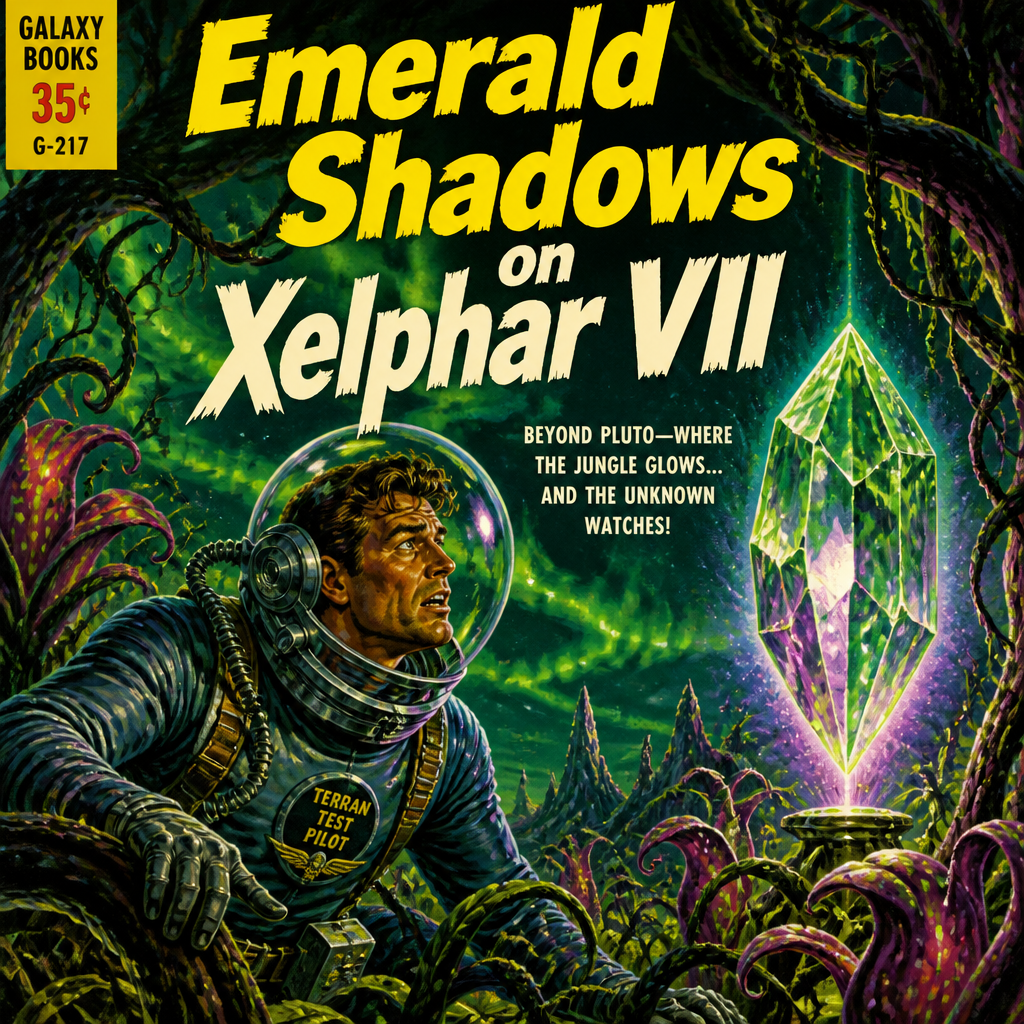
Official Field Observation Log: Mission X-52B
Date: 17 October 1952
Observer: Captain Lenhardt Hale, Test Pilot – Experimental Interplanetary Recon Unit
Location: Xelphar VII, a jungle world orbiting in the dim outskirts beyond Pluto.
It began as a routine atmospheric sweep. The X-3 Rocketplane broke through Pluto’s fragile exosphere into the whispering void, speeding towards a green flicker dancing beyond the frigid outer system. The dimensionless jungle planet called Xelphar VII shimmered in the unnatural eerie glow of a persistent emerald aurora, casting elongated, twitching shadows over the colossal flora. The air electric with unseen life and secrets.
Touchdown was less graceful than hoped. The dense thicket grabbed at landing struts as I fought to steady the fuselage — an embrace of vines like grasping fingers eager to consume. Once ashore, the claustrophobic thrum of the alien undergrowth was immediate and oppressive. Thick leaves arching overhead blocked most of the aurora’s sickly light; yet the forest pulsed with bioluminescence from unseen insects, reflecting off countless glossy alien crystals embedded in the gnarled trunks. Not natural gems, but something alive — vibrating with a faint inner light, casting jittering emerald reflections that danced maddeningly across my visor.
My mission: to retrieve and examine one such crystal specimen believed to be central to Xelphar's peculiarity. Early field reports suggested it might be an organic conduit for bioenergy — a possibility rivaling the best speculative theories orbited around back on Earth. Yet here, the air hums with something unspoken. Something waiting.
Over four hours, I advanced through the tangled nightmare of sentient foliage and lurked shadows, each step more a negotiation with this living labyrinth. The trees seemed to breathe, groan, and — possibly — watch. The temperature hovered stiflingly warm; humidity clung to the flight suit like a second skin. Above, the ghostly green aurora rippled with whispering patterns that defied my efforts to track. The feeling of being enclosed within a primal maw was unrelenting.
Finally, I stumbled upon a clearing. At its heart, like a pulsar in a sea of darkness, rested the singular alien crystal specimen. Larger than my fist, it hung suspended in mid-air, thrumming with a kaleidoscopic light — hues shifting from emerald to violet with a cadence matching my racing heartbeat. Its facets moved like liquid glass, distorting the jungle behind it into grotesque and distorted shadows.
Gingerly, I reached out with the retrieval tool, but as I broke the boundary, the forest roared. The ivy-thick vines writhered violently, restricting my movement. The crystal emitted a sharp harmonic tone, resonating through the soil and bone alike, and for the briefest moment, I felt linked — a mutual awareness exchanging in a pulse of shared cognition.
- Specimen Designation: Xelphar VII Bio-crystal GX-9
- Observed Properties: Levitation, bio-electromagnetic resonance, adaptive light refraction, responsive to physical contact.
- Field Behaviour: Defensive reaction triggering aggressive plant movements.
- Environmental Conditions: Warm, oppressive humidity; continuous spectral green aurora; high electromagnetic interference.
- Pilot Status: Fatigued, claustrophobic distress but physically unharmed.
Withdrawn through the bracken, the crystal secured, I marked my position on the star map for future expeditions. A fragile hope stirred: this glowing relic might unlock the secrets behind Xelphar VII’s strange ecology and, perhaps, the physics behind the perpetual aurora strangling this world’s skies.
Yet as the X-3 lifted from that claustrophobic jungle floor, the alien light dwindling below, a lingering whisper on the radio caught my ear — garbled but insistent — as if the crystal had sung a valediction into the void.
“Xelphar VII is no mere rock drifting beyond Pluto... it lives, thinks, and waits.”