The Halcyon Halt of Wuthenberg
An 1847 memorandum on an uncanny discovery at a forgotten East Prussian railway station
Memorandum
From: The Anonymous Correspondent
Date: 17th October 1847
Location: East Prussia, Wuthenberg Halt
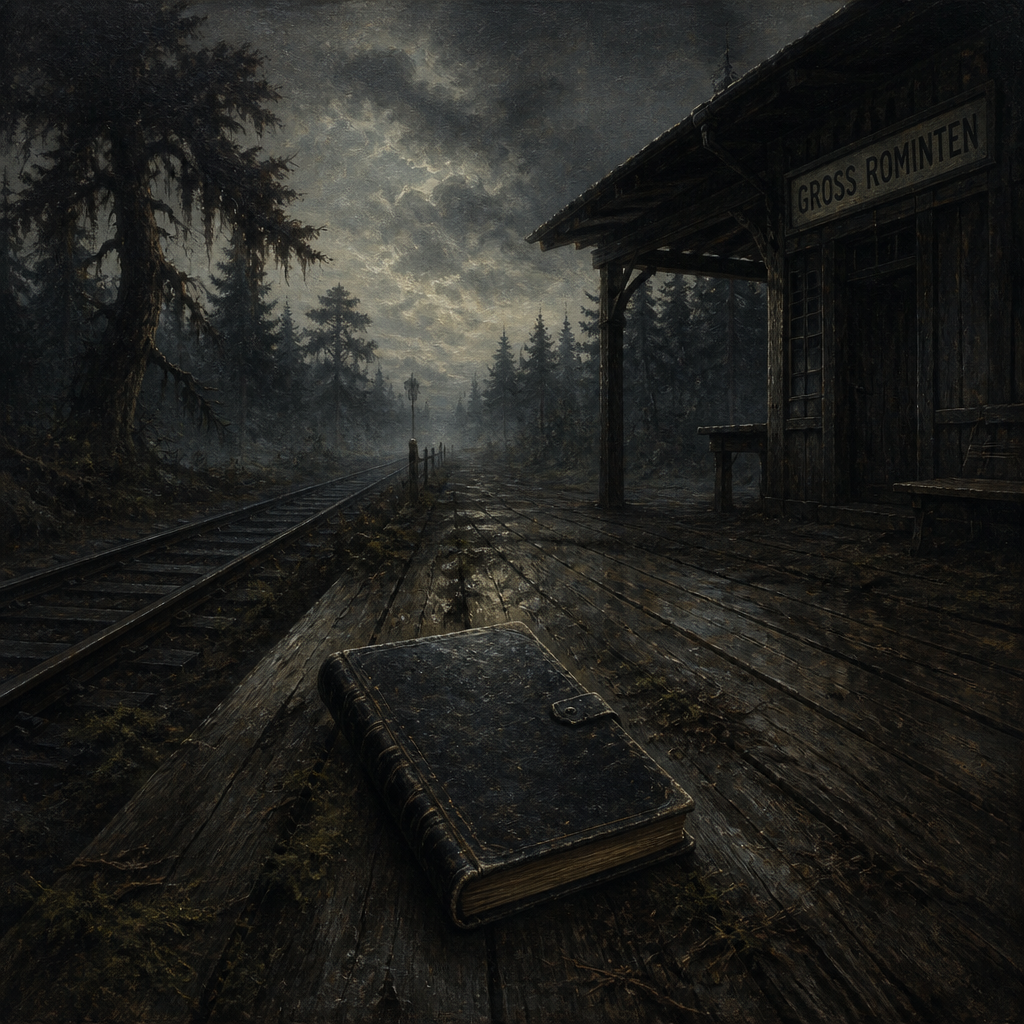
Within the dense, brooding forests of East Prussia lies the forsaken railway halt known locally as Wuthenberg. Foregone by time and obscured now by the encroachment of the wilderness, the site presents itself as a spectral imprint: a relic of a hastened industrial ambition, now swallowed by the oppressive stillness of the primeval woods. On the day of this account, the air hung heavily, unmoistened by even the smallest zephyr; an unnatural stillness as though the very breath of nature had been halved or hushed.
It is here that I discovered a singularly curious object: a black notebook, its cover unyielding and matte, as if fashioned from some material beyond common leather. The tome lies beside the derelict platform, half-buried under a scattering of damp leaves and the detritus of bygone travellers—a dark heart amidst the ruin and desolation. That such an artifact should endure so near an abandoned nexus of iron and wood, where the world’s commonplace movements have ceased, is at once disturbing and potent.
The pages, yellowed and brittle, held entries penned in an elegant but erratic hand, the script seeming to writhe and coil with each line as though imbued with some restless animation. The nature of the writing is not strictly chronological but appears as a series of fragmented observations and nocturnal reflections, marking dates and odd hours suggestive of an obsession that eclipsed civil time. One finds therein mention of apparitions—shadowy passengers glimpsed but never fully seen—whose presence charged the stagnant air with an otherworldly menace.
Among the passages:
- “The whistle calls, yet the train never comes—only the endless tick of the clock mocking the stillness.”
- “At midnight, the platform glimmers with a spectral light, and the silence itself seems pierced by distant lamentations.”
- “Passengers who disembark are never heard from again, swallowed by the dark woods beyond with no footprints or sign.”
The memorandum is conscious of the traditional rationality that East Prussian scholarship prizes. Yet, the tone of the correspondent drips with a palpable dread, an oppressiveness matched by the thick, motionless air of the halt itself—suggesting that this is not merely a matter of idle superstition but a real unfolding of eldritch phenomena entangling the iron veins of progress with ancient shadow.
It is worth noting that the railway line to which Wuthenberg Halt once belonged was among the first to traverse these northern wilds, a line notorious both for accidents and whispered tales of vanished passengers. The Black Notebook seems to confirm these legends—the harmful interface of the modern and the unquiet past recorded in dreadful detail, an uneasy testament that the spectral and the mechanical may yet be kinsmen rather than strangers.
My final observation: as I left, the oppressive stillness thickened, and the black notebook seemed to pulse faintly beneath my coat, though no breath stirred the trees nor sound disturbed the air. I am compelled to entrust this memorandum to your care, for the railway halt of Wuthenberg speaks not only of loss but of a hidden threshold where time, matter, and shadow collapse—there to be consumed by the silent scream of the void.
End of Memorandum