The Glass Star Gambit
A Space Explorer’s Suspicious Tale from the Green-Aurored Orbital Observatory, 1949
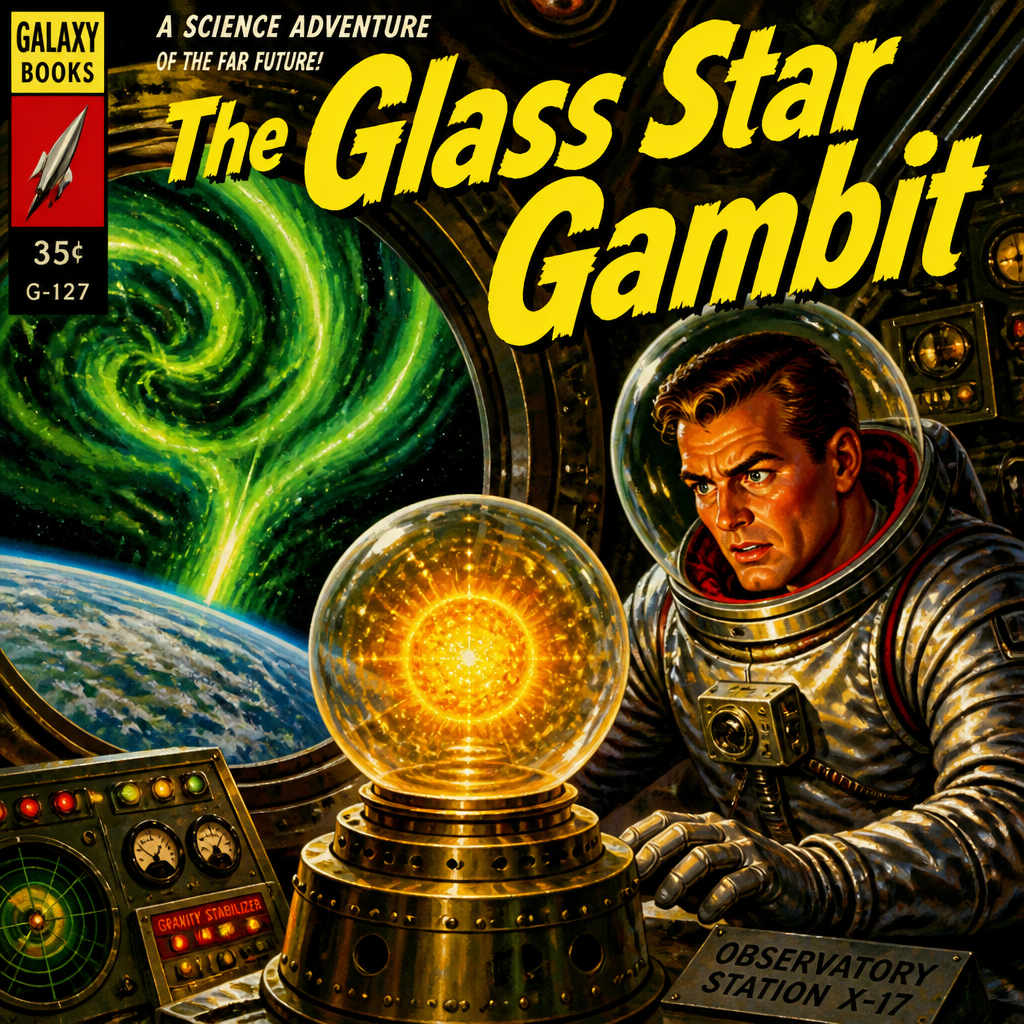
Seen from the Cold Vastness!
Above Earth’s writhing emerald skies, where unnatural green auroras dance like spectral serpents, the Orbital Observatory Zeta-9 hangs in silent vigil. It is 1949, and humanity’s reach into the cosmic dark has never seemed so tenuous—or so perilous.
Enter Captain Dex Marlowe, a space explorer with a jittery glare and a private ledger full of cosmic conspiracy notes. Marlowe’s latest mission: safeguard an object so strange that it could unsettle the very balance of interstellar politics—a miniature star, encased within a seemingly fragile glass sphere, humming with impossible energy.
What is the Glass Star?
The miniature star, a flickering orb no larger than a grapefruit, defies all known laws of physics. Born from the reckless ambitions of Dr. Kyril Volkov, a reclusive physicist vanished after rumours swirled of an experiment gone catastrophically wrong, the glass sphere contains a contained fusion reaction; a self-sustaining nuclear fire imprisoned behind an ancient, iridium-reinforced glass of unknown origin.
The Orbital Observatory holds the lone specimen, a ticking cosmic curiosity that could promise infinite power or ignite interplanetary disaster.
Paranoia in the Auroral Shadow
Strange things began when the auroras erupted one eerie January night, casting eerie green shadows across the observatory’s metallic surfaces. The radiation readings fluctuated inexplicably, with the star’s glow pulsing in synchrony. Marlowe’s crew whisper rumours of shadowy figures seen near the docking tubes, and communications reports crumbled under unknown interference.
- Observation One: The sphere appeared to emit subtle gravitational waves—detectable only by the most sensitive instruments—and they seemed to carry encoded signals.
- Observation Two: The power levels fluctuated not randomly, but almost rhythmically, as if the star were alive, conscious, and perhaps brooding inside its glass prison.
- Observation Three: Captain Marlowe’s personal logs hint at secret transmissions intercepted from unknown extraterrestrial origins, possibly linked directly to the star-sphere.
Behind the Curtain of Cosmic Mystery
Despite orders from command to keep the sphere under strict quarantine and commence full scientific study, Marlowe knows better. Something about the glass star’s very existence defies the optimistic front of the burgeoning Space Age. The star might be a weapon, yes—but a living map, a cosmic beacon, or a curse sent from the depths of the galaxy’s forgotten corners? He fears the arrival of an alien faction, drawn by the star’s clandestine pulse.
As the unnatural green aurora continues its sinister ballet outside the portholes, time grows dire. Can Captain Marlowe unravel the truth before shadows consume the observatory—before the glass star’s silent flame burns out or causes the end of Earth’s fragile orbit?
From the pages of The Interplanetary Weekly Observer, 27th January 1949, your trusted narrative into the strangeness beyond the stars.