The Lacuna of St. Veit’s Chapel
An archaeological note on a spectral anomaly discovered in a forsaken East Prussian mortuary sanctuary, 1847
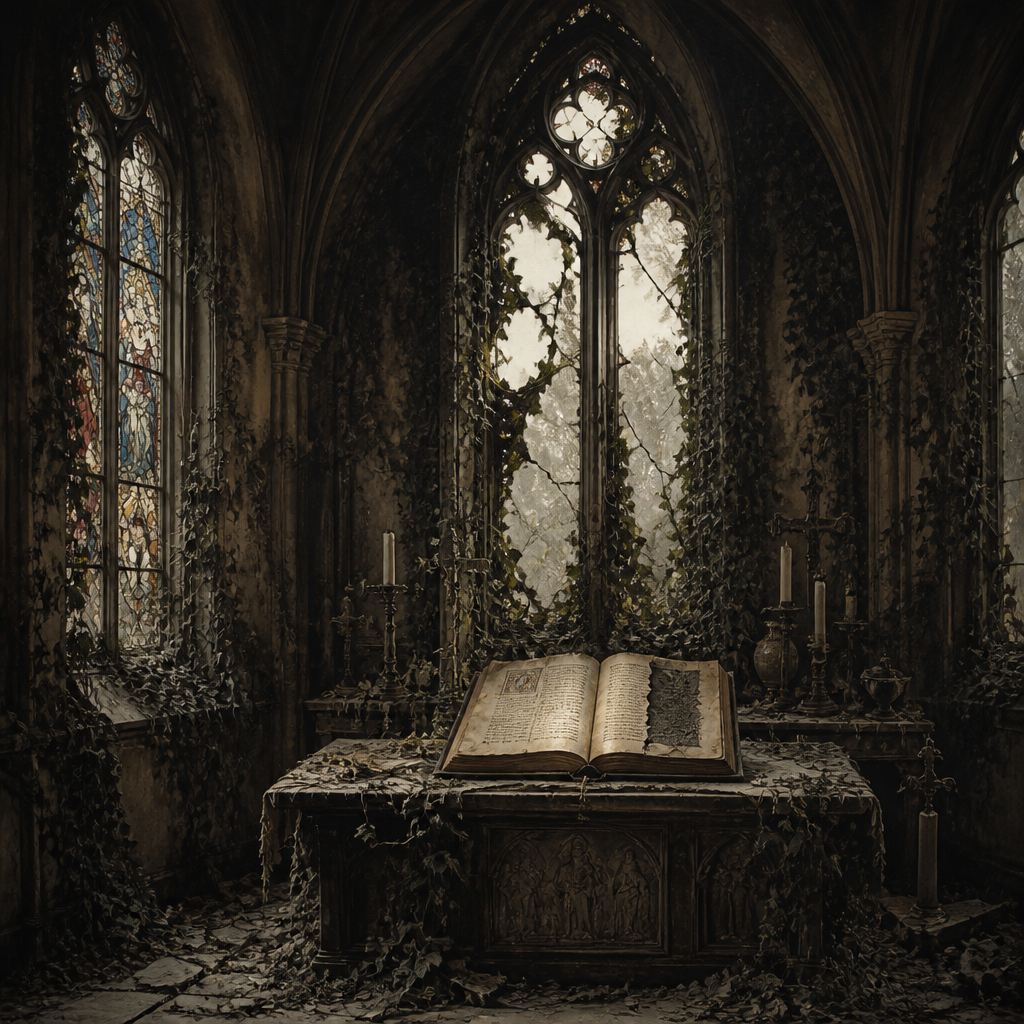
In the summer quarter of the year 1847, beneath the pallid sky of East Prussia, I undertook an investigation most peculiar within the confines of St. Veit's Chapel, a forsaken mortuary chapel lying in neglect amid the crumbled stones of a once-venerable cemetery. The air was oppressively still, devoid of even the faintest breath of wind, as though nature itself hesitated to disturb the somnolent silence that hung like a shroud over the hollow grounds.
St. Veit's has long stood abandoned, its gothic arches choked by ivy and the detritus of decades forgotten. Amongst the fractured pews and the fragments of stained glass, I discovered an object of curious consequence: a prayer book, bound in what seemed to be faded vellum, resting upon the altar's skeletal remains as if placed there by unseen hands. The volume was aged and worn, the edges of the pages yellowed and brittle, but what seized my attention was the conspicuous absence of a single leaf, torn from the centre of this devotional manuscript.
Despite repeated examination, I found no trace of the missing page within the chapel walls or the immediate earth. This absence was not the product of mere decay or vandalism; it bore an unnatural void, as if the page had been effaced from existence rather than simply removed. The remaining folios bore prayers in archaic High German script, invoking protection against infernal spirits and the restless dead, yet with a particular emphasis on the "larva nocturna"—an apparition, or perhaps a curse, scarcely mentioned in ecclesiastical records save for a few brittle manuscripts in distant archives.
The melancholy of the scene was unabating. Beneath the still air, the chapel seemed poised between worlds, its silence thick and expectant. The flickering rays of a weak sun filtering through fractured coloured glass painted spectral patterns across the stone floor. Each shadow cast by the remnants of funerary statuary appeared animated with latent grief, as though the very stones mourned the desecration of their sanctity.
The Unseen Page
My attempts to reconstruct the missing prayer’s nature by reference to other liturgical codices have proven inconclusive. The lacuna itself feels, almost palpably, a portal: its absence more potent than presence. A hypothesis arises that this excision was intended: a deliberate erasure wrought to bar invocation of a blasphemous rite, or to conceal knowledge too terrible for mortal contemplation.
Local legend obscured by time hints that St. Veit’s, in some remote memory, was the site of rites condemned as profane by ecclesiastic authorities. Could the chapel have been a locus for forbidden supplications to nether denizens? And if so, does the prayer book remain as a relic of such dread liturgies, or a ward against them?
Reflections of the Archivist
I find myself haunted by the persistent stillness within the chapel’s realm. It recalls the oppressive calm of the crypts beneath Königsberg’s cathedral, where all sound dies save the whispered regrets of shadows.
The missing page, paradoxically, invites a contemplation of absence as a presence; a negative space in the spiritual geography of the place that palpably disturbs the soul. It is as though the void left by its loss absorbs the very essence of prayer, leaving the chapel suspended in a liminal melancholia, between sanctity and blasphemy, life and the necropolis.
As I depart this forsaken ground, the silence remains unbroken, and the stillness, unyielding. St. Veit’s chapel endures as an enigma embroidered with shadows, where even breath seems an intrusion, and where the vanished prayer lingers in spectral omission.
- Location: St. Veit’s Cemetery Chapel, East Prussia
- Date of Examination: July 1847
- Meteorological Note: Air completely still, no observable wind
- Object: Vellum-bound prayer book with central page missing
- Condition: Neglected structure, desolation pervasive
- Character: Unnamed scholarly archivist, author of these notes
May these reflections serve those who seek not only the tombs of the dead but the veiled secrets of their prayers.