The Porcelain Visage of Gütterswald
An account of a fractured mask and a weary keeper amidst the desolation of an East Prussian estate, autumn 1847.
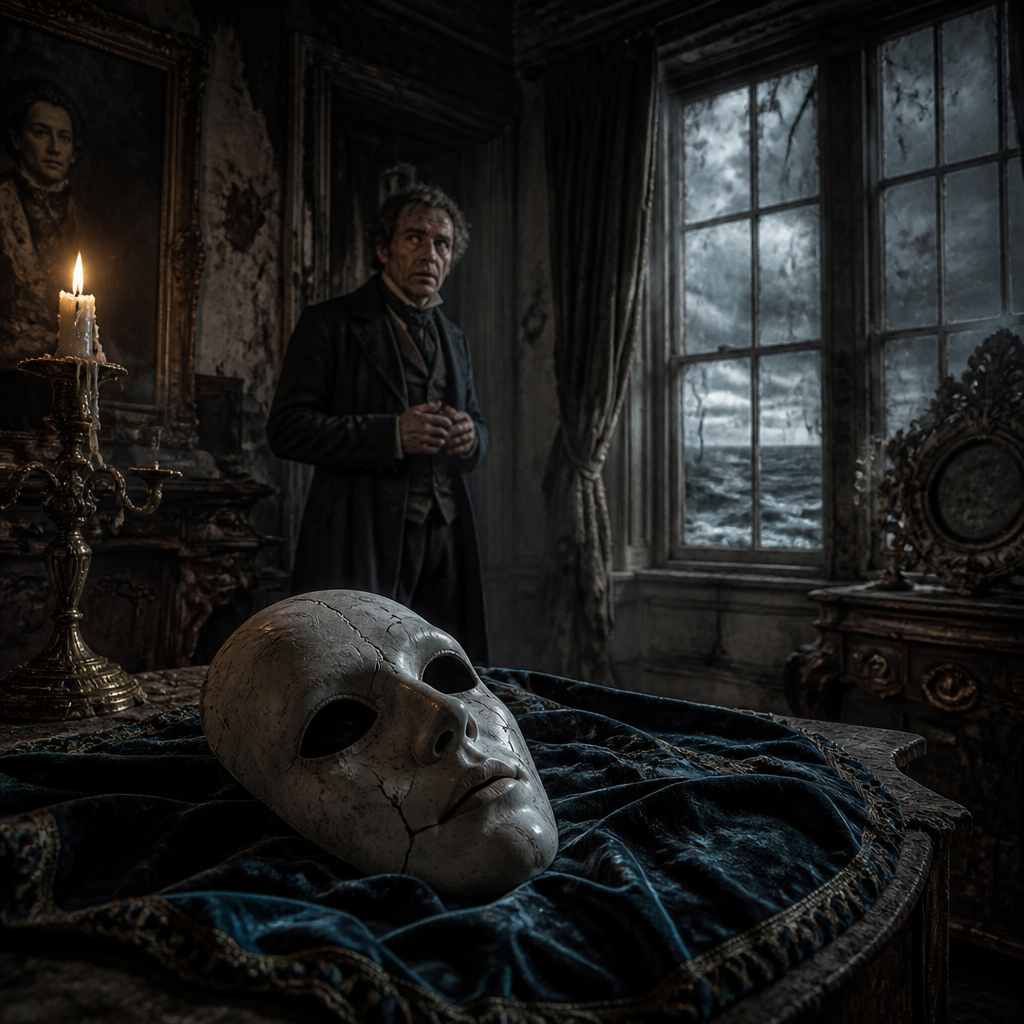
As the cold sea winds howled with merciless intent over the Baltic shore, I found myself ensconced within the crumbling walls of Gütterswald Manor, a once-proud estate abandoned to time and shadow. The year was 1847, and the chill that pressed through the vast windows seemed to seep not only into the bones but into the very spirit of the house.
My guide, the manor’s reluctant caretaker, a certain Herr Klausen, was a man of few words and tremulous manner. Upon my arrival, his sallow visage was shadowed by anxiety, and his tremulous hands revealed a habitual nervousness, as if he were perpetually on the brink of revealing a fateful secret.
The Manor and Its Memories
Gütterswald once rang with the laughter and music of an old noble line, but in its present solitude it seemed rather a mausoleum, caught in eternal twilight beneath the overcast sky. Great oaken staircases groaned under the weight of years and neglect. The portraits of stern ancestors watched with eyes both watchful and melancholy, as though guarding the memory of events better left undisturbed.
The Caretaker’s Warning
Herr Klausen spoke reluctantly of the manor’s peculiar curio, sealed away in a neglected cabinet within the drawing-room. His voice lowered when he recounted the mask — a cracked porcelain visage said to possess a sinister history:
- A delicate and expressionless countenance, once flawless, now spider-webbed with fractures.
- A relic from a long-forgotten ball during the Harz winter of 1823, wherein a noblewoman vanished without trace.
- A superstition that the mask bore the imprint of a restless spirit, condemned to wander behind its serene facade.
One might have dismissed such tales as folklore were it not for the palpable unease that Herr Klausen exhibited in their telling, and the shiver of wind that seemed to whisper warnings through the cracked panes.
The Mask Disclosed
At last, with trembling hands, the caretaker fetched the object. The cracked porcelain mask lay beneath a stained velvet cloth, pale and haunting under the flickering candlelight. Its eyes, empty and blackened by age, confronted me with an eerie sentience.
It was not merely an artefact, but rather a vessel of frozen anguish; one could almost perceive the faintest echo of suffering behind its serene features — a sorrow that refused to fade.
Herr Klausen implored me silently to leave it be, for he believed, in the solemn quiet of the manor, that to gaze too often upon the visage invited a malediction, as though the fractured mask might one day weep tears of porcelain and reclaim the souls of the unwary.
Departure and Reflection
As I departed the forsaken Baltic shores, the breath of the sea carried with it a mournful lament. The image of the cracked mask remained seared into my memory — a haunting symbol of beauty and despair intertwined.
This solemn visitation to Gütterswald Manor affirmed the inexorable passage of time and the spectral shadows it leaves behind — whispers of lives vanished but never forgotten.