The Mask of Bleeding Rain
An anonymous letter from 1847 recounts the sinister discovery within Königsberg’s municipal archive
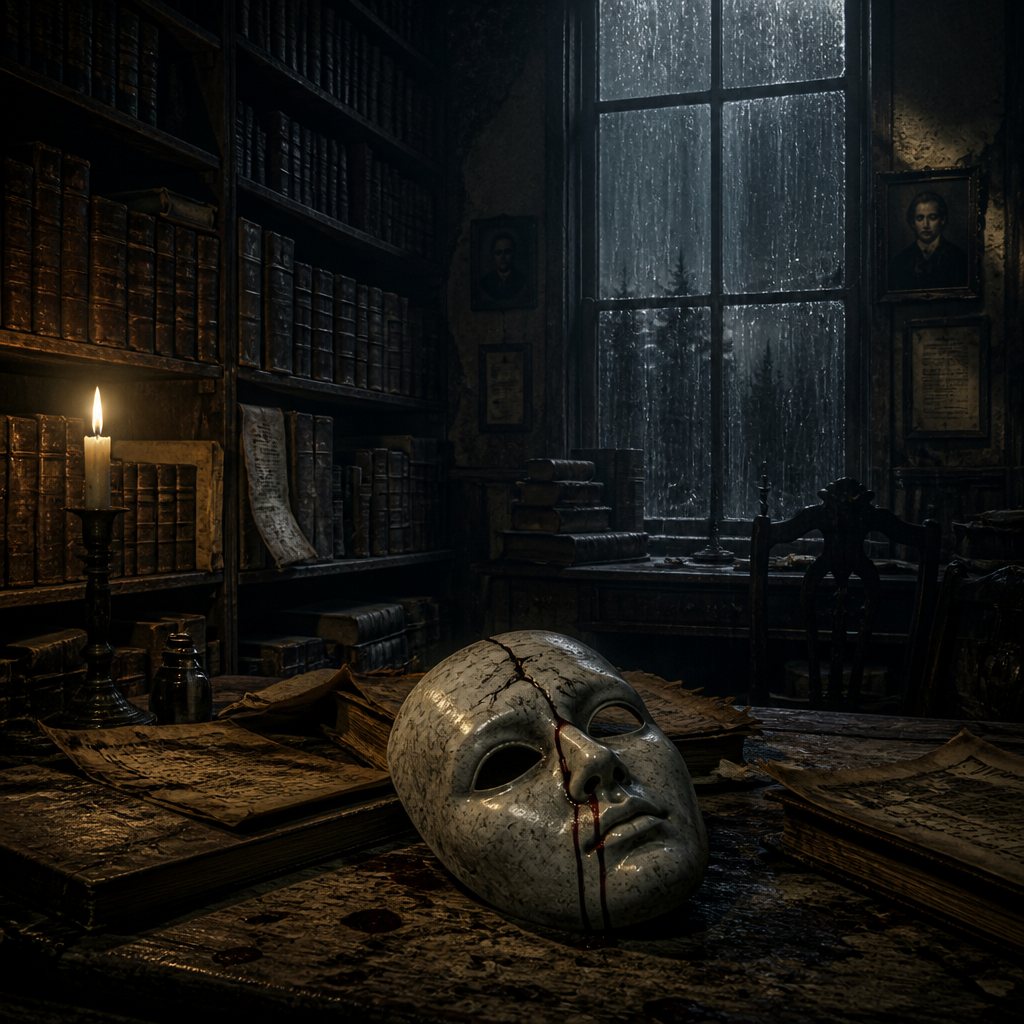
From the Shadows of Königsberg’s Archive
In the year of our Lord 1847, beneath unceasing skies mottled with ceaseless rain, there lies a chamber in the bowels of Königsberg’s municipal archive that none but the archivists dare to enter. It is said to be locked, not merely by heavy bolts of iron, but with a dread older than the city walls themselves. Herein rests a curiosity whispered among the humblest scribes, preserved not for its nobility but for the weight of its portent.
An anonymous correspondent, whose name is lost to time—and eye—has laid bare the chilling tale in a missive, inked in black and penned with trembling hand. The letter, discovered folded among brittle official papers, extols an ominous artefact of porcelain; a cracked mask, smooth as alabaster, yet disfigured by what might be mistaken for a sanguine fissure, though no true blood stains these fragments.
The Mask and the Uneasy Rain
The writer’s words seep uneasily through the letter’s folds, as if the rain itself had saturated the parchment. They describe the mask as not merely fractured but alive with a spectral semblance, an accursed visage eternally caught between serene beauty and the agony of an unknown torment. The crack runs jagged from forehead to chin, as though a violent truth had sundered the peace of this brittle face.
It was during a storm, an unbroken deluge of rain the like of which the gates of Königsberg have seldom witnessed, that the mask was unearthed. The municipal archive’s custodians, engaged in inventory, stumbled upon the object hidden beneath layers of forgotten registry ledgers and rusted keys. To touch the mask, the letter conveys, was to invite a creeping malaise, an itching at the soul’s edges, and voices like the clatter of distant thunder moaning just beyond hearing.
In the Letter’s Own Words
“At the hour when the rain matched the tears of a forsaken widow and the wind carried the laments of dead soldiers, I beheld the cracked mask. It lay cradled by dust and darkness, its silence screaming louder than any tempest.”
The correspondent’s tone drifts between stark witness and fevered reverie, a testament to the mask’s troubling power. They confess to an urge to shatter the visage utterly, that one might silence whatever secret it presses beneath its fragile surface. Yet superstition, or something more dreadful, forbade such destruction.
The Legend That Lurks Beneath
Though evading the precise origins of the mask, the letter hypothesises its birth in the fires of war—perhaps the Napoleonic conflagration that once swept these lands—as a theatre prop for a tragedy unscripted and a soul unredeemed. One can almost imagine the silent horrors it witnessed; a reflection of grief and wrath, bound in cold porcelain for eternity.
The persistent rain, the letter intimates, is itself a manifestation of the mask’s curse, a mourning that prevents reprieve for this forgotten relic. It is an eternal dirge falling upon Königsberg, dulling the light and thickening the shadow.
A Final Warning
As the letter closes, the anonymous writer warns against curiosity’s lure. To pry open the locked municipal archive, to disturb the cracked mask beneath layers of time and rain-damp gloom, is to invite unsettled spirits anew. The correspondent’s last words echo with a desperate solemnity:
- “Leave the mask to sleep beneath the weeping skies, lest the city be drowned not by water, but by the revenants it harbours.”
Thus ends this spectral epistle, a relic of the past caught in the stifling grasp of present unease. The cracked porcelain mask, idol of sorrow and silence, remains locked away, its story half-spoken and wholly unquiet.